
Dear Supporter,
 Our analysts have just left the Government’s Budget lock-up having pored through the largest budget media/analysts pack we can recall and listened to an early version of Finance Minister Grant Robertson’s speech which he has just read to Parliament.
You can read our summary comments to media here.
Except for the appropriations, Budget documents are essentially political. The key announcements the Government is hanging its hat on, are listed at the bottom of this email.
Government books and the economy looking rosy
Robertson’s first budget was written in extraordinarily benign circumstances. The economy is growing at a sustainable rate of around 3%, tax revenues for the June 2018 year will exceed Budget 2017 estimates, unemployment is down to 4.5%, employment levels are very high at 73.1%, and public debt at 21.7% of GDP is low and trending downwards.
The economy is in vastly better shape than any new Government has inherited since 1972. That year Labour leader Norman Kirk won with a thumping majority and an inexperienced team. Labour lost to National’s Rob Muldoon, with a similar majority in 1975, and no more clues as to how to manage structural problems with the economy, which led to the economic crisis of 1984 and the Lange/Douglas reforms.
Prime Ministers Bolger, Clark and Key would have been over the moon if they could have assumed office with today's economic fundamentals.
Two big wins for taxpayers:
- Fiscal responsibility
It is very encouraging that the Government is remaining within the pre-election ‘Budgetary Responsibility Rules’. We think Steven Joyce's allegations that Labour had an $11.7 billion hole (which Labour vehemently denied) had also been helpful in keeping the Government restrained in the face of criticism from some on the left who say they should borrow more.
- Independent election policy costing office
Budget 2018 announced that “public consultation will be launched in August on establishing an independent body to better inform public debate in our democracy.” This is something the Taxpayers’ Union has been pushing for since 2014 – for transparency and accountability of what political party policies will cost taxpayers.
For decades political parties during election campaigns have made allegations about expenditure policies of others. That’s why we worked so hard last year with our election “Bribe-O-Meter”.
Tax cuts for hot horses
In terms of tax relief, unless you breed horses you are out of luck. Winston Peters has announced $4.8 million in tax reductions for ‘high quality’ horses (defined in the media release as being based on bloodlines, looks, and racing potential!).
More corporate welfare (this time green)
The Greens’ major budget announcement was a “Green Investment Fund” to “transition to a net-zero-emissions economy by 2050.” The budget sets aside $100m for this corporate welfare capital funding.
Treasury forecasts average earner paying top tax rate by 2022
Budget 2018 projections show that the average worker will be on an annual income of $72,000 by 2022. That puts them in the highest income tax threshold (33%) which still kicks in at $70,000.
This was inevitable after eight successive Budgets that have not delivered income tax relief, or indexation of tax brackets. We will be using these new projections in the next round of submissions to the Tax Working Group to push for indexation.
Growing the pie vs dividing it
Overall, Budget 2018 is far more focused on dividing the pie than growing it. With the exception of the already announced R&D tax credits, there is nothing to stimulate business confidence, industry, investment, and wages.
In terms of the R&D tax credit scheme, our view is that the breaks are marginally better than handing out corporate welfare grants (which are bureaucratic intensive with high transaction costs) but will almost certainly lead to gaming of the tax system.
Initial reaction
In the weeks to come our team will be working through more of the detail, but in the mean time our initial comments to media are available here:
Labour Delivers Predictable Budget In Sweet Economic Times Barrie Saunders
A Billion Dollars A Year For 900 Fewer Tertiary Students. WTF? Jordan Williams
Megan Woods Breaks Word – Gives Into Callaghan Self-Interest Jordan Williams
Government Acknowledges Merits Of Full Capital Expensing – But Why Just Bloodstock? Joe Ascroft
Budget Win For The Taxpayers’ Union With Announcement Of Independent Costing Office Joe Ascroft
New Green-Tint Corporate Welfare Scheme Mistaken Joe Ascroft
Treasury Predict Average Working Paying Top Tax Rate By 2022 Joe Ascroft
Thank you for your support in ensuring there is a strong voice for taxpayers in the corridors of power.

Barrie Saunders
Chairman
New Zealand Taxpayers' Union
Key announcements of Budget 2018
- $4.05 billion for Health, including:
- $2.2 billion in additional funding for DHBs.
- $362.7 million in free GP visits for under-14s and subsidised GP visits for community service card holders.
- $750 million in capital funding over the forecast period for hospitals and health infrastructure.
- $100 million in capital funding for deficit support will be available to DHBs in the 18/19 financial year.
- $1.934 billion for Education, including:
- $394.9 million in capital funding for new schools and classrooms.
- $370 million for 1,500 new teacher places by 2021.
- $590.2 million in additional funding for early childhood education.
- $249.3 million in additional funding for learning support programmes.
- $1.216 billion for Justice, including:
- $298.8 million to fund an additional 1,800 police officers over the next five years.
- $1 billion for R&D tax credits over five years.
- $1 billion in funding for the Provincial Growth Fund, including:
- $245 million for the One Billion Trees planting programme over ten years.
$904.9 million in additional funding for Foreign Affairs, including:
- $190.7 million in direct funding to the Ministry of Foreign Affairs and Trade to hire an additional 50 diplomats and open an embassy in Sweden.
- $714.2 million in additional foreign aid and development spending.
- $367.7 million in additional funding for the Defense and Veterans portfolios.
- $100 million for a 'Green Investment Fund' to invest in low-emissions projects and businesses.
- $181.6 million in additional funding for the Department of Conservation
 This morning our team delivered
 We look forward to hearing the Working Group acknowledge not just our own submission, but those of the 800 or so taxpayers who have submitted via our website.


 New Zealand Police handed out $2,505,317 in clothing allowances to non-uniformed staff in 2017, according to figures obtained by the New Zealand Taxpayers’ Union.
 Five months after it was requested under the Official Information Act, Callaghan Innovation has now released its 2016/17 entertainment expenses.
 The New Zealand Taxpayers’ Union has today released the full breakdown (attached) of Callaghan Innovation’s entertainment expenses for 2015/16.
 The
The 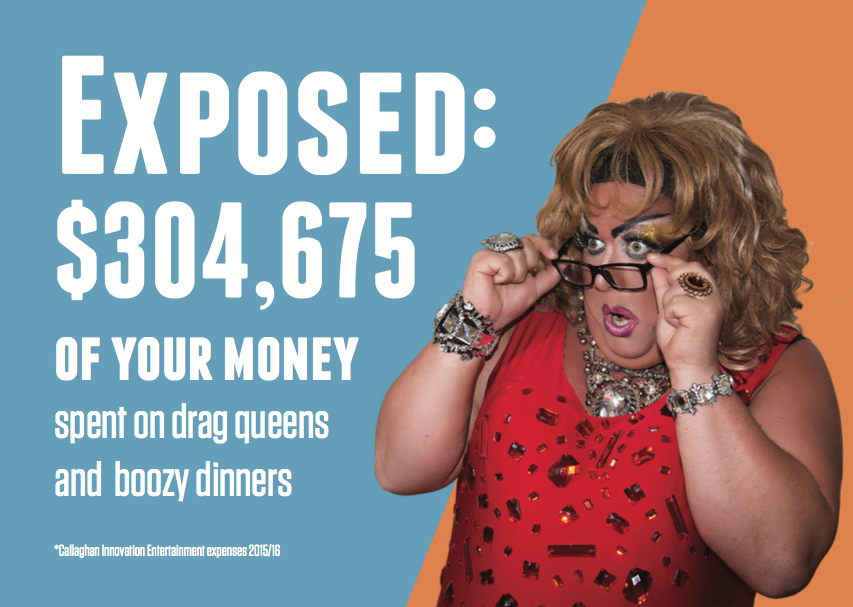


 Yesterday, the post-election "
 Earlier this week
 The CEO of Wintec, Mark Flowers, appears to be scared of the media. He's reportedly spent an incredible $175,000 of public money hiring lawyers to protect him from the local


 When the new Government was formed, Deputy Prime Minister, Winston Peters, let slip that a "hidden addendum" to the Labour-NZ First coalition agreement had been agreed to, which clarified how the new Government will operate. Mr Peters promised that the document, apparently 38 pages long, would be released at a later date.
 "We call on Jacinda Ardern to respect the official information act and release the secret 38-page addendum to the Labour - NZ First coalition agreement."


 Labour’s coalition agreements with New Zealand First and the Green Party were released on Tuesday. While they set out the policy priorities of the new government, they do not breakdown the costs. Failing to mention the expenses, both in the agreements and most of the media commentary, should be of real concern to taxpayers.

 As a result of these illegitimate figures, Auckland Council came out much better in our local government league tables than justified. It appears the Council has coordinated responses to deliberately mislead the public on what the average ratepayer pays.
 Today's Waikato Times covers our call for Waikato DHB Chair, Bob Simcock, to follow his disgraced Cheif Executive, Nigel Murray, and resign
 We've been looking into this story for some months, and the DHB had, in fact, refused to give us details of the expense claims on the basis that it was subject of an employment investigation. Now that Mr Murray has resigned, we'll be contacting the DHB on Monday to get details of those expenses. A resignation is no reason to keep something secret, even if we never know of the (now moot) outcomes of the investigation.


 Well known former Wellington lobbyist and former journalist, Barrie Saunders, has been appointed to the board of the New Zealand Taxpayers’ Union.
 In the final Bribe-O-Meter update before the election, the Taxpayers’ Union has put together the combined manifesto costings for a range of potential coalitions. These figures will allow voters to gain a better understanding of the fiscal implications of a potential Government over the next three-year parliamentary term.
 A National-ACT coalition has promised the lowest new spending, combining for a total of $5.9 billion, or $3,441 per household. National has promised $8.3 billion, and ACT a net-reduction in spending of $2.4 billion over three years.


 For the first time ever, the ACT Party is the biggest spender in this week's update of the election Bribe-O-Meter. ACT’s big jump is on the back of its education policy, costing $3 billion over the next parliamentary term. This week the Bribe-O-Meter also sees Labour and the Green Party jump by more than $1 billion and National by approximately $0.5 billion.
 Following on from
 Transparency Rating


 In this weeks update, all parties currently in Parliament have been added to the Taxpayers’ Union Bribe-O-Meter, which tracks the costs of election policies as they are announced.


 Up to 55% of calls from taxpayers are being rejected by the IRD because it does not have enough staff rostered on to answer the phones, according to data supplied to the Taxpayers' Union covering a 2-week period in May this year.
 The Green Party’s attempt to increase the welfare state in their
 The Dunedin Mayor’s
  NZ First has announced its ‘carpet policy’ - to line all Government offices with wool carpets.
 In
In  Today we have released our latest report, ‘Socialism for the Rich’, by Jim Rose. The report shows that the annual cost of corporate welfare is now $1.6 billion - or $931 per New Zealand household.
 The efficiency of the Office of Treaty Settlements' travel arrangements needs examination, after just nine officials racked up a $57k travel bill to the Chatham Islands alone, in only 18 months.
  The Office have blamed the quality of internet on the Chathams as restricting other means of communication, but the local council there advised us that the internet works perfectly fine. They said that people can even come into their offices and use video call facilities.
 The tax threshold changes in last month’s budget will see the largest relative tax savings go to those who already shoulder the smallest relative burden: middle-income earners. That's the conclusion of Mac Mckenna's latest report - updating
 Further to our earlier exposés of


 Statistics New Zealand’s new lease with Wellington’s Chow Brothers for offices at 318 Lambton Quay signs up taxpayers for $794 per square metre per year — an astronomical amount for office space.
 Currently, only New Zealand First are blowing the whistle on this issue. The question is, why haven’t the other parties done their homework and held Peter Dunne to account for what appears to be an enormous own goal? His reform, which he’s sold on the basis of ‘efficiency’ will, in fact, cost New Zealanders’ hundreds of millions over the next few years alone.
 A report released last week by the OECD (a group of mostly rich countries), ‘
 For some reason the report does not include the ACC levy – which effectively adds another one percentage point to the effective rate. It also ignores Kiwisaver deductions because it is not ‘compulsory’. It is worth noting that Kiwisaver is an opt-out scheme. Opt-out schemes are very close to compulsory in reality as not many people actually bother to opt-out (a well-established fact in behavioural economics). This will make the New Zealand rate look misleadingly low compared to a country such as Australia where the super contribution is compulsory.
 The Government’s failure to index tax brackets to inflation since 2010 now costs the average Kiwi income earner almost $500 each year according to a new report released today by the Taxpayers’ Union. The report, "5 Options for Tax Relief in 2017", models five options to deliver meaningful tax relief packages which could be part of Budget 2017 with fiscal implications of $3 billion or less.
 In addition to modeling various options for tax relief to compensate New Zealand families who are paying more, the report calls for tax thresholds indexed to inflation going forward. That would prevent Wellington increasing the average tax rate paid by New Zealanders every year, raising extra revenue for the Government, in real terms, without the transparency of actually raising taxes.
 Living Wage Aotearoa New Zealand nobly want to alleviate poverty and reduce unemployment with their activism for a living wage, but the evidence to date shows they are achieving the exact opposite. This report shows that a living wage will only make it harder for low wage earners to find work.
 A Taxpayers’ Union briefing paper on research looking at the public accessibility of municipal artworks is available below.
 Stuff.co.nz; the NZ Herald; and even international media have now picked up the story:
 With
With 

 Following feedback from a number of members and supporters who emailed or phoned our office, we have launched a petition calling on the Minister of Foreign Affairs, Murray McCully to veto MFAT giving anymore NZ Aid money to the Clinton Initiative.
 If we are to have an official measure of child poverty then it needs to meet two criteria. One is that there is multiparty agreement on it (as for example there is on the Household Labour Force Survey to measure unemployment), and secondly, it actually has to measure poverty and deprivation, and be able to track progress in reducing it.
 New Zealand's soaring house prices are a symptom of a deeper problem, and one man has had the wisdom and courage to hit the nail on the head. That man is Labour MP Phil Twyford of Te Atatu, but his sound strategy has taken a backseat to knee-jerk grandstanding within his party.
 The Taxpayers’ Union is questioning why NZ Aid money, meant to help the world’s poorest, is being used to support countries and governments with their own space programs. The figures (see below) show that since 2010 more than $214 million of taxpayer money has been given to countries rich enough to fund their own space ambitions.
