2026 Election Bribe-O-Meter
As political parties announce their policies leading up to the General Election, our independent economists will crunch the numbers, fisk their costings, and show you just how much all the promises add up to. The information below covers all spending policies announced up to Monday 12 October 2026.
| Party | Total cost of announced spending promises | Cost per New Zealand household |
|---|---|---|
| ACT | -$17.86 billion | -$8,619 |
| National | $5.16 billion | $2,489 |
| Labour | $33.18 billion | $16,012 |
| NZ First | $51.80 billion | $25,000 |
| Opportunity | $229.42 billion | $110,724 |
| Green Party | $247.22 billion | $119,316 |
| Te Pāti Māori | Too vague to cost overall | N/A |

Bribe-O-Meter Week 6: ACT save $8,619-per-household while NZ First hits $25,000-per-household in new spending. Opportunity announce unfunded $11 billion pay equity splurge
After being the first party this election to promise net spending reductions last week, ACT have doubled down. $17.86 billion in net savings would be worth $8,619 per household.
$6.88 billion, or $3,318-per-household, of this is from a target to return non-frontline government spending to its 2017 level per person, adjusted for inflation and wage growth. A further $748 million is saved from cutting the demographic ministries, $1.13 billion from reducing foreign aid, and $793 million from trimming environmental spending outside of the emissions trading scheme.
A further $4 billion, or $1,931 per household, comes from trimming the operating allowance from $2.4 billion to $2 billion a year, and $379 million is saved through reductions in welfare admin costs. The rest comes from raising the super age to 67 ($4.06 billion), ending the KiwiSaver contribution ($2.21 billion), continuing the suspension of NZ Super Fund contributions ($1.43 billion) and tightening welfare ($0.97 billion).
Overall, ACT’s plan finds $22.60 billion of savings and spends $4.74 billion of that on new promises, led by a $2.00 billion capital contingency for a National Cancer Centre. ACT’s tax changes are not included in the Bribe-O-Meter, but would result in $6.29 billion in tax relief worth $3,037 per household (leaving out their $236-per-household ‘Carbon Tax Refund’, which we count as a spending measure).
National’s fiscal plan, on the other hand, adds to the tally. While closely tracking PREFU, it takes National’s spending promises from $3.84 billion to $5.16 billion, or $2,489 per household. The Belfast to Pegasus motorway ($800 million), Pharmac funding increases ($604 million) and two more years of school lunches ($452 million) drive the rise, partly offset by $1.01 billion of savings from foreign aid and welfare.
Opportunity has quietly committed to restoring the old pay equity regime as part of its ‘disability position statement’. Treasury have costed this at $10.97 billion, or $5,295-per-household. This appears nowhere in any of their costings, and takes their total to $229.42 billion ($110,724-per-household).
Labour’s only new spending this week is an equally quiet promise to restore 43 rural school bus routes, which we have costed at $11.04 million. Last week, we exposed a $17.9 billion (now $8,654-per-household) gap between what their fiscal plan had costed and their actual policy announcements. For context, Labour’s unfunded gap is larger than all of ACT’s net savings combined.
New Zealand First have passed the half-a-century mark this week, taking their total to $51.80 billion ($25,000-per-household). Their $2.4 billion plan to increase Working for Families payments carried them over the line. More than half of their total ($26.70 billion, or $12,884-per-household) is for buying the BNZ.
The Greens’ $4.86 billion ($2,346-per-household) youth jobs scheme takes them 98.9 percent of the way to the big quarter-of-a-trillion milestone. And Te Pāti Māori’s kōhanga reo, kura, and Māori artists announcements take the costable portion of their policies to $5.98 billion. Most of their platform is still uncostable position statements.
In the transparency ranking, ACT move up a full star to 4 after releasing their fiscal plan, joining National. Opportunity drop half a star for sneaking out a $10.97 billion unfunded pay equity pledge.
Key Findings*
- National has promised $5.16 billion in new spending over the next four years. This equates to $2,489 per household.
- Labour has promised $33.18 billion in new spending over the next four years. This equates to $16,012 per household.
- The Green Party has promised $247.22 billion in new spending over the next four years. This equates to $119,316 per household.
- NZ First has promised $51.80 billion in new spending over the next four years. This equates to $25,000 per household.
- ACT’s promises now amount to a net saving of $17.86 billion over the next four years, or $8,619 per household. This reflects the savings in its fiscal plan, net of its new spending.
- The Opportunity Party has promised $229.42 billion in new spending over the next four years. This equates to $110,724 per household.
- Te Pāti Māori have announced more costed policies this week. Their costed policies now total $5.98 billion, or $2,887 per household. Because so many of their policies remain uncosted, we have again not included them in this week’s totals, but we are watching closely.
* As of 11:59pm 12 October 2026. Detailed workings can be found here.
Party spending breakdowns
You can read detailed breakdowns of each party's policies (and the costs) here:
- National Party cost breakdown
- Labour Party cost breakdown
- Green Party cost breakdown
- ACT Party cost breakdown
- NZ First cost breakdown
- The Opportunity Party breakdown
Breakdown by spending area
- 🏭 Economic Development 🏭
- 🏛️ Government Services and Administration 🏛️
- 🎨 Environment, Art, and Culture 🎨
- 🏥 Social Spending 🏥
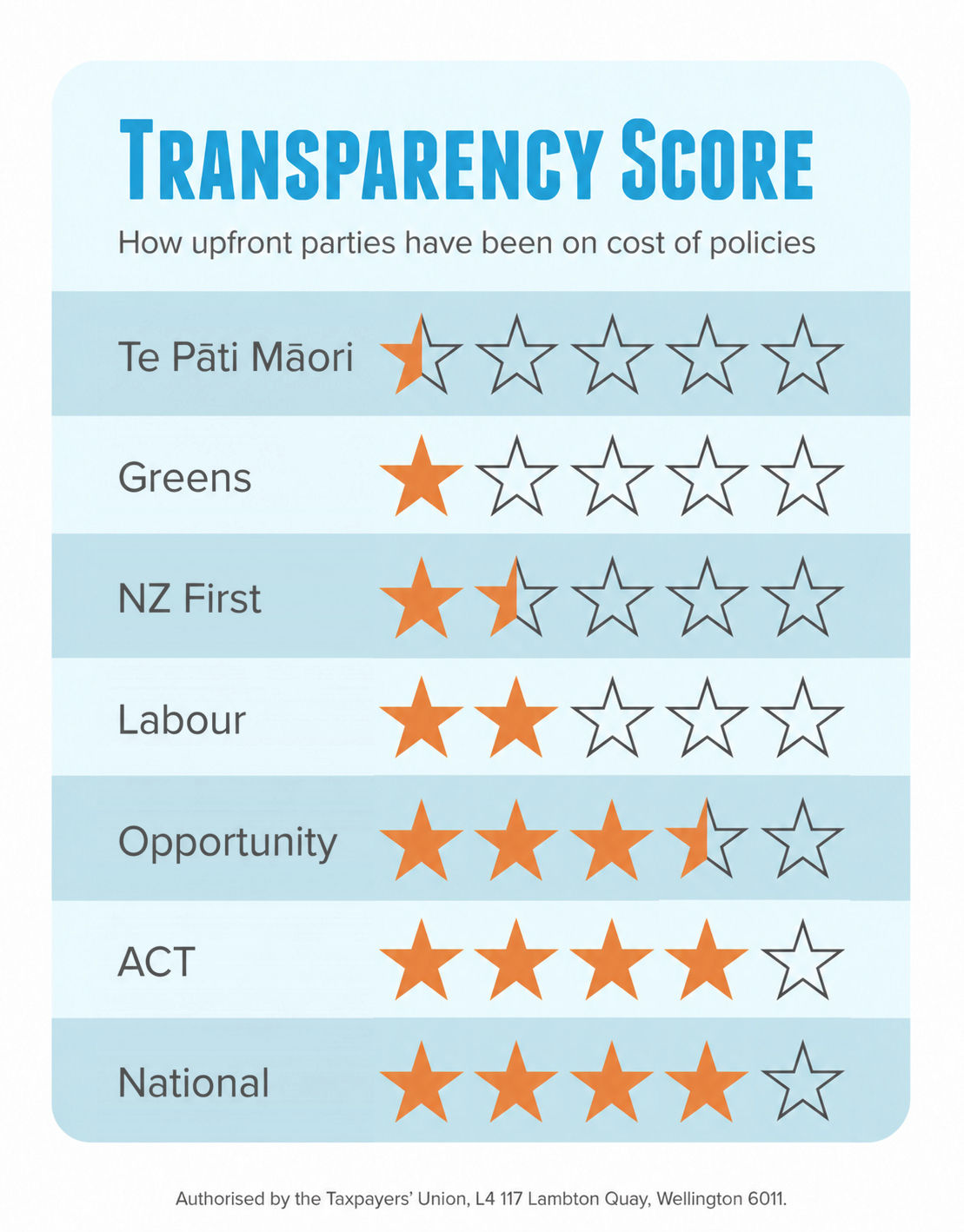
Transparency Rating
As part of the Bribe-O-Meter, our economic staff have assessed political parties' transparency across
policy detail and cost and given each a score out of five (see below).
The most transparent party has
been National, closely followed by ACT. Opportunity have been relatively strong performers, but between
uncosted announcements and no fiscal plan they are starting to slip.
Labour have fallen from 4 stars to 2 since this project began. The least transparent are Te Pāti Māori, closely followed by the Greens and NZ First.
Bribe-O-Meter Week 5: $18 billion gap in Labour’s fiscal plan; Greens’ spending plans approach quarter of a trillion
Labour has this week released its pre-election fiscal plan, which it calls “fully costed and fully funded”. The Bribe-O-Meter begs to differ.
Excluding health cost pressure funding, which matches the Government’s own forecasts, the plan lays out $11.12 billion of new operating spending over the four years. It reports a further $4.13 billion of capital commitments separately for a total of $15.25 billion. We have costed Labour’s announcements at $33.17 billion, or $16,007 per household. The $17.9 billion difference, or $8,649 per household, is spending Labour has promised that does not appear in its plan. That total includes $149.2 million we have added for school lunches in 2031, where Labour’s plan leaves these unfunded.
The biggest omission is pay equity. Treasury projects the cost of reinstating the regime at $10.97 billion ($5,295 per household), but Labour’s plan costs only the $4-an-hour pay rise for care and support workers for about a quarter of this total. Lifting foreign aid towards 0.7 percent of GNI would cost $5.52 billion if Labour gets there by 2030/31, but they still refuse to put a timeline to their explicit promise to do so. And the dividends forgone by diverting them to the Future Fund would cost $2.78 billion. Those three alone come to $19.27 billion, or $9,299 per household.
Labour’s plan also holds health funding flat in the fourth year, yet says the same funding will help deliver its graduate nurse job guarantee and free cervical screening, neither of which has its own line in the plan. Continuing the Government’s current track would add about $1.5 billion that year on our estimate. However, we have not added it to Labour’s total, because it is essentially a continuation of the Government’s spending track, and no party’s costings include it.
Their plan also contained a $146.8 million error, banking the cost of reversing the Government’s income-related rent and accommodation supplement changes as a $73.4 million saving over four years. We have corrected this for Labour, who have agreed to fix their plan.
The Greens are now so far ahead in their spend-up that we might need to extend the graph. Their total has hit $242.28 billion, or $116,931 per household, driven this week by a suite of transport policies. Rail and light rail are now costed at $21.07 billion, free and capped public transport fares at $1.28 billion, and councils’ public transport shortfalls at $824 million.
National’s only new costed announcement this week is $1.85 billion for the first stage of the Mill Road project in Auckland ($1.75 billion) and route protection for later stages ($100 million). That takes their total to $3.84 billion ($1,853 per household).
ACT’s plan to end the Government KiwiSaver contribution for members who receive employer contributions would save $2.59 billion over four years. That takes ACT’s total new spending into the negative, with a $1.88 billion saving for taxpayers ($907 per household). That is only half of the policy: ACT would also remove tax on KiwiSaver earnings, which costs about $5.0 billion in lost revenue and sits outside the Bribe-O-Meter. ACT’s own costing for the whole policy is a net cost of $2.4 billion.
In the transparency tracker this week, we have moved Labour down a full star for leaving $18 billion of its promises out of its fiscal plan. This brings them down to 2 stars, compared to their 4-star ranking at the start of this project. All other parties remain unchanged this week.
Bribe-O-Meter Week 4: Labour spends $10 billion in a week; $2,662-per-household uncosted foreign aid boost drags them down the transparency rankings
Labour have been the big hitters this week, announcing more than $10 billion in new spending. That is $5,032 for every household in the country, in the space of seven days.
Labour’s plan to fund at least 6,000 additional social housing places, repair at more than 2,000 schools, and maintain hospitals is costed at $4.3 billion. Their student loan policy, announced at its campaign launch, adds a further $583 million, or $282 per household.
But the biggest movement this week had no costings at all. Labour have quietly committed to ramping foreign aid spending up to 0.7 percent of Gross National Income. Conservatively assuming that they take the full four years to achieve this, that’s another $5.5 billion in spending by our maths. Or, in other words, $2,662 per household sent straight overseas.
That takes Labour’s specifically announced policies to $33.24 billion, or $16,041 per household. When Labour promised to lift spending to 33 percent of GDP, we wondered how they’d get there. The gap between their costed promises and that $50.47 billion spend-up has now narrowed to just $17 billion. Another two weeks like this and they’ll blow through it.
Most other parties have kept their cards close. National’s announcements this week were clarifications of existing spending plans, and are already accounted for in its $1.99 billion total. ACT add another dollar per household to their total, with noise cameras to catch loud vehicles.
We have also added the cost of a lobbying register to both the Greens and Opportunity. The Greens announced theirs this week as part of a political donations package. We have costed a register at $11.6 million, or $5.60 per household. Until now, we had taken Opportunity at their word that the cost of their own register would be negligible. Registers, it turns out, need registrars.
Te Pāti Māori have now tripled their number of costed policies…to three. Alongside last week’s $1 billion energy fund, they have announced a $3.1 billion kai sovereignty fund, and $200 million for a takatāpui commission. These total $4.3 billion, or $2,075 per household.
Just those three total more than National and ACT combined. But with so many of their policies still impossible to cost, we remain reluctant to add a partial figure to their total. We are reviewing whether to include the party weekly.
On transparency, Te Pāti Māori move up half a star for starting to put numbers to their policies. Labour move down half a star. Not even attempting to quantify more than $5.5 billion, or $2,662 per household, in new foreign aid spending and hoping it would go unnoticed is not a strategy we endorse.
Bribe-O-Meter Week 3: Opportunity blows past $100,000-per-household as Te Pāti Māori joins the race. But where are NZ First’s numbers?
It has been a big week for spending other people's money. Most visibly in a clutch of whacko supermarket policies threatening to drive away investment for good, but also of course with the usual taxpayer-funded slush.
Labour want supermarkets to run their wholesale arms separately from their stores, and to make price gouging illegal. Whatever the merits of tackling grocery competition, forcing an incumbent to restructure its own business is not a cost-free intervention, even if the bill for it lands on the companies rather than the Crown. The direct taxpayer cost is confined to beefing up enforcement, which we have costed at $88.6 million, or $42.75 per household.
The Opportunities Party have now blown through the $100,000-per-household mark, closing quickly on the Greens. Their $5 billion Climate Resilience Fund adds $2,413 per household on its own. On top of that, the interest bill on their proposed $60 billion infrastructure borrowing programme comes to $12 billion, or a further $5,792 per household.
The Greens still holding on to pole position, this week promising $200 million for the promotion of te reo Māori and a new commercial rent tribunal, costed at $7.2 million.
National's additions this week have had limited fiscal impact: a referendum on MMP ($16.6 million, $7.99 per household) and $5 million for a Commerce Commission study into breaking up Foodstuffs, together adding $10.40 per household. ACT, meanwhile, have kept their cards close to their chest. Their changes this week have been regulatory rather than fiscal, and we have nothing to add to their tally as a result.
But of course the big news is Te Pāti Māori's first properly funded policy. The party has pledged $3.1 billion to a Kai Sovereignty fund, equivalent to $1,496 per household. Of course, this naturally includes $100 million of your money for building community gardens.
We have marked NZ First down this week. The party has announced fifteen new health policies under its "Make NZ Healthy" banner with no costings of its own attached to any of them. We have costed the package at $2.1 billion, or $1,019 per household, driven overwhelmingly by an assumed pay increase for nurses. We look forward to NZ First reaching out with their own figures, as ACT did last week.
Bribe-O-Meter Week 2: Labour and Opportunity spend big. Greens go to ground
Most parties have kept their powder dry in week two of the Bribe-O-Meter, with only a handful of major announcements.
Labour are this week's biggest spenders. They have matched National's promise to increase KiwiSaver employer contributions by 2032, while also continuing contributions for those on parental leave. Together, we have costed these policies at $392 million, or $189 per household.
Alongside a new Office of AI and an online safety regulator, costed at a further $29 million, Labour's commitments this week add another $203 per household to taxpayers' bills.
Opportunity are close behind, promising a fund to encourage Kiwi industry to electrify, costing four years' worth of ETS revenue, or $407 million.
New Zealand First have also announced a raft of immigration policies, including a 10-year welfare stand-down for visa holders, which we estimate will save taxpayers $68 million. But that is dwarfed by a roughly $2 billion downward revision to the savings from restricting superannuation to citizens, after confirming the policy would not take effect until 2029.
National, meanwhile, have announced another $28 million for extra transport policing.
It has been a tale of two halves on transparency this week. ACT got in touch to clarify that its Pharmac funding increase would be paid for through savings elsewhere in the health budget. That brings its total new spending commitments down from $2.6 billion to $708 million and earns the party an extra star in our transparency rankings.
We have marked NZ First down this week, for offering no meaningful costings for their superannuation and immigration reforms. The Greens have also had a poor week, refusing to engage with us over their KiwiMart costings. Cabinet papers cited in their own policy document suggest buying the supermarkets and distribution centres would cost almost three and a half times what the party claims.
Despite our invitation to explain where their cheaper figure comes from and update the Bribe-O-Meter if they seemed reasonable, the Greens have instead continued to hide behind Parliamentary secrecy.
Bribe-O-Meter Week 1: Tracking the Cost of This Year's Election Promises
For the first Bribe-O-Meter update of this election campaign, we've put together the manifesto costings for each of the main parties, and the election campaign announcements so far, so voters can start to see what the parties are promising to spend, and what it will cost taxpayers.
Each week between now and the election on 7 November, we will update the Bribe-O-Meter. So keep checking back every Wednesday to see what new policies have been announced over the week before, and how the running totals for each party are shaping up.
Consistent with previous election Bribe-O-Meters, the figures assume each party spends what it has promised, and do not account for the tax changes some parties have also proposed. Nor does it try to guess what policies might change once governing/coalition arrangements are negotiated after the election.
Something not quite right? Tell us!
One of the objectives of the Bribe-O-Meter is to encourage politicians and parties to be more transparent about the details of their policies and the cost implications. We strongly encourage engagement and public clarification of policy and costing assumptions that sit behind their manifestos. Email us via [email protected] if you spot an error or want to chat to us about what sits behind any particular numbers. We might not always agree, but we certainly want to hear, understand, and (where possible) disclose the different assumptions.
Support us in spreading the word — and educating voters on what this year's election policies cost
Elections are expensive — that's why we've worked hard to create this year's Bribe-O-Meter.
Help us spread the word with targeted Facebook advertising of the Bribe-O-Meter so that more New Zealanders learn what the election bribes will cost them as taxpayers. You can make a confidential donation here. Thank you for your support.
FAQ
What is the methodology and how is the information displayed?
The Bribe-O-Meter compiles the political promises of each of the main political parties and places them within the major spending portfolios.
It assumes that a party elected on 7 November will last for a full three-year term and can fully enact their policy agenda. Policies announced that do not come into effect during the next Parliament will not be included in the figures.
Given that the purpose of the Bribe-O-Meter is to track spending pledges announced by politicians, it does not model the effect of tax cuts or tax increases and the effect they have on households.
Tax credits and rebates have been considered as constituting new spending.
Will you work with political parties to correct or refine the numbers?
Absolutely! We want to provide the public and media with as much information as possible. If there are errors or a party disagrees with our assessment of their costings, we hope that the Bribe-O-Meter will encourage the parties to provide the public with more information and transparency.
How have you costed each policy?
For some policies, we have taken parties at their word. For uncosted policies, we have calculated the figures ourselves. And in some cases, where parties' costings are just unbelievable, we have offered alternative costings. Explainers for each can be found at www.taxpayers.org.nz/bribe_o_meter_workings.
How often will the Bribe-O-Meter be updated?
The Bribe-O-Meter will be updated on a weekly basis, with updates published every Wednesday between now and the election.
Are the graphics free to use?
Yes, the graphics are free to use, but we ask that they are attributed to the New Zealand Taxpayers' Union.
Why do some parties' bars go beneath zero on the Bribe-O-Meter?
When a party's savings in a category outweigh its costs, that category nets negative. The clearest way to represent this on the graph is to have the category sit below zero.