The New Zealand Taxpayers' Union has today released a new report, Green with Envy: Wealth, Death, and Trust Taxes Examined, exposing the real-world impact of the Green Party's proposed $17 billion tax grab. The report finds the policies would hit far more than the super-wealthy, catching homeowners, farmers, retirees, and small business owners across the country.
Taxpayers’ Union Policy Analyst, Austin Ellingham-Banks, said:
"The Greens are proposing one of the most aggressive tax regimes of its kind anywhere in the developed world, resulting in a broad-based raid on Kiwis who’ve worked hard, saved, and built something over a lifetime."
"The idea this only hits the wealthy simply doesn't stack up. One in five Kiwi homes is held in a trust, and the Greens would tax those assets from the first dollar. In Auckland, that means an annual bill of over $18,000 on a mortgage-free family home, or $3,600 for first home buyers with a 20 percent deposit."
"And it doesn't stop there. A 33 percent death tax would force many families to sell farms, homes, or businesses just to pay the bill. Inheriting the average dairy farm would trigger a $1.2 million tax bill. There is nothing fair about taxing grief, or taxing the same income again when it's earned, saved, and finally passed on."
"Most countries that have tried wealth taxes have scrapped them because they drive investment and talent offshore. Death taxes are even worse, New Zealand tried one and abandoned it in 1993 because it crushed farming families and raised almost nothing."
“This package is light on evidence, heavy on populism, and green with envy.”
The New Zealand Taxpayers’ Union has released 103 Ways to Save Money in Local Government – a report that lists big and small opportunities for local councils to save money and reduce the rates burden on ratepayers.
The 103 suggestions, many of which were provided to the Union by councils and media stories across the country, range from the common-sense to the novel.
Taken together, they serve as a challenge to reimagine undisciplined council spending. Avoiding wasteful spending should not be a cause for celebration, but an expectation.
After a Taxpayers' Union campaign, rates caps are now Government policy. Councils have to find ways to save money, and this report is a way to get the ball rolling.
Some highlighted suggestions:
- Pay down council debt (#1)
- Installing water meters (#7)
- Leaving social housing to Government (#50)
- Performance based pay (#61)
- Leaving climate reductions to the Emissions Trading Scheme (#103)
Some more novel ideas:
- Ending sister city deals (#2)
- Rental grazing for underused land (#18)
- Phasing out postal billing (#39)
- Move to electronic agendas (#47)
- Offering flu jabs to staff (#79)
Whanganui Mayor Andrew Tripe, in a foreword to the report, said:
“The Taxpayers’ Union’s scrutiny is welcome. It sharpens our focus and keeps public discussion where it belongs: on results for households. I look forward to continuing to work with central and local partners to keep Whanganui moving forward — delivering the basics well, protecting household budgets, and giving permission to dare to dream about the so-called nice to haves which make our communities more liveable.”
Taxpayers’ Union spokesman Rhys Hurley said:
“By sharing examples of councils that have achieved real efficiencies, we hope to encourage the adoption of best practice, reduce wasteful spending, and help restore public confidence in local government.”
The Taxpayers’ Union would like to thank the Councils who responded to the Union's invitation to submit ideas and examples of how their councils have saved ratepayer money.
The New Zealand Taxpayers' Union has today launched its latest report assessing Labour's unfair, unworkable approach to a capital gains tax.
The report, entitled 'Why Labour's capital gains tax fails the fairness test', criticises the policy for taxing inflation, setting up Kiwis who are no better off in real terms for five or six-figure tax bills.
The policy also lays the groundwork for an administrative nightmare by forcing a valuation day, and overlooks businesses by making no mention whatsoever of same-asset class rollover relief. Small businesses who want to buy a new shop may be stung for hundreds of thousands of dollars, despite not liquidating assets. This will be a disaster for growth, prices and jobs.
Finally, the policy simply won't be able to raise enough money to meet Labour's revenue aims, meaning this capital gains tax will be the thin end of the wedge for more comprehensive capital gains or wealth taxes to meet the shortfall.
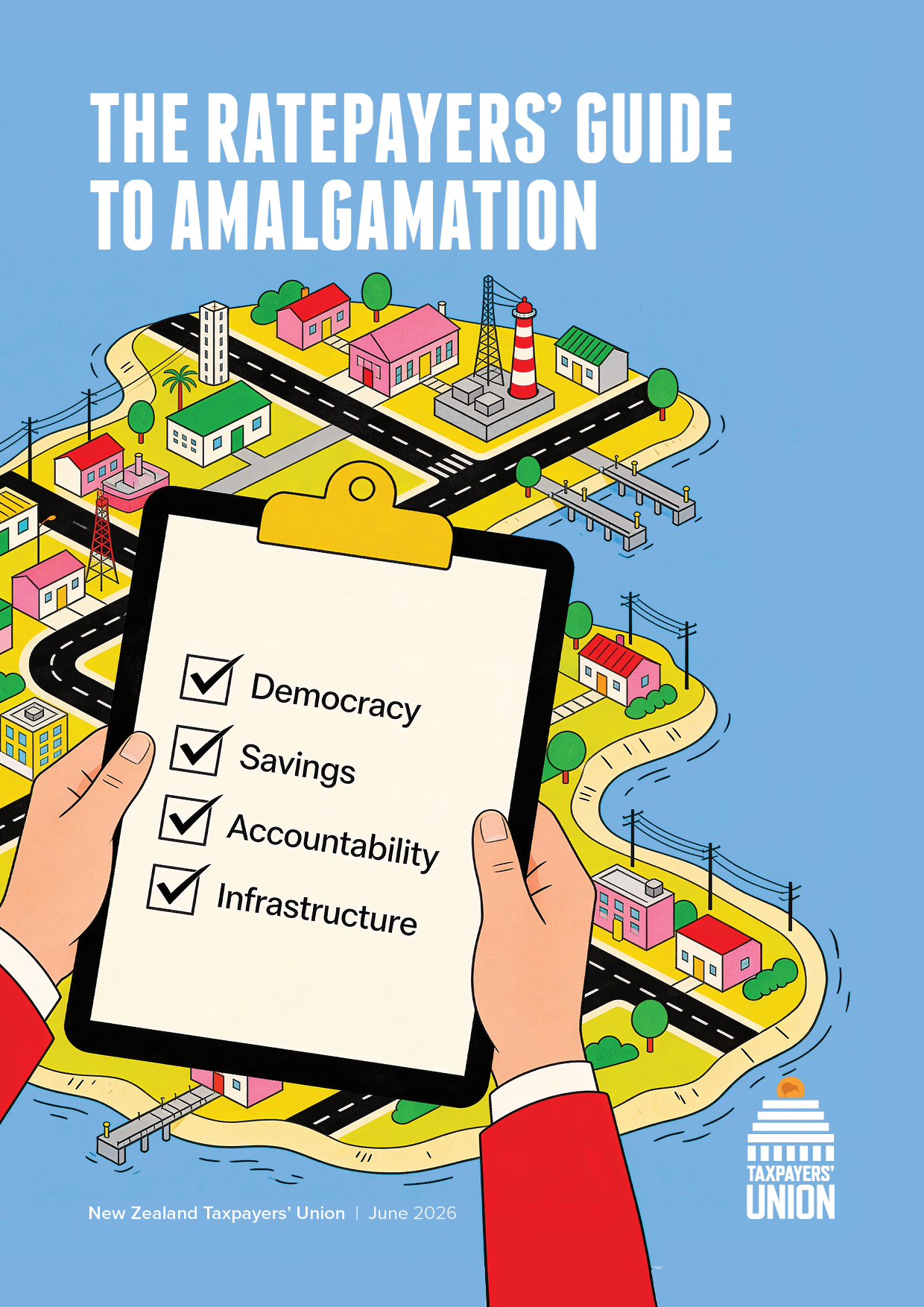
Rates are soaring, transparency is declining, and too many councils are distracted from their core tasks. Whether it’s funding vanity projects, hiring communications staff instead of fixing potholes, or embarking on ideological crusades, councils are too often putting their own agendas ahead of the ratepayers they are supposed to serve.
The numbers speak for themselves. Council debt has ballooned in the last decade, and last year alone, average residential rates increased by almost 15 percent across the country. And despite all their spending, public satisfaction with council performance is falling. Infrastructure is failing, planning processes are sluggish. As a result, voter turnout in local elections continues to decline.
New Zealanders deserve better.
The proposed solutions in this paper are not radical, but are intended to reduce waste and improve performance across the sector. Local government should be lean, transparent, and focused. It should deliver high-quality services at a reasonable cost and be held accountable when it doesn’t.
These reforms are a roadmap to achieving that. This is how we build better councils.
Going for Growth: Taxpayers’ Union urges Government to adopt Full Capital Expensing in new briefing paper
The New Zealand Taxpayers’ Union is today launching the first in a series of briefing papers aimed at tackling the country’s long-standing under-capitalisation and low productivity. Titled Going for Growth: Full Expensing of Capital Expenditure, the paper makes the case for a tax policy with a proven track record of boosting investment, productivity, and wages.
Full Capital Expensing allows businesses to immediately write off the cost of new equipment, machinery, and technology, rather than spreading the deduction over years under complex depreciation schedules. This policy has been successfully implemented in the United States and the United Kingdom, driving economic growth and increasing tax revenue in the long run.
The briefing paper can be downloaded here (or read below).
Economic growth is not just a theoretical concept—it’s the key to higher wages, better public services, and greater economic opportunities for future generations. Full Capital Expensing is a no-brainer that would supercharge investment and make New Zealand businesses more productive.
With Finance Minister Nicola Willis set to deliver Budget 2025 in less than three months, the Taxpayers’ Union is urging the Government to seize the opportunity and implement the policy to come into effect on Budget night.
If Christopher Luxon is serious about growth, Full Capital Expensing should be at the top of his agenda. And if the Government really want to put a rocket under the economy, they could adopt the ‘use it or lose it’ approach used by Donald Trump and Rishi Sunak – making the policy time-limited to encourage businesses to bring forward investment decisions.
The briefing paper highlights the success of Full Capital Expensing in other jurisdictions and details how New Zealand can implement it effectively.
Politicians love to dangle short-term sweeteners in front of voters, but real economic growth comes from policies that drive productivity. Unlike tax cuts designed to boost consumer spending, Full Capital Expensing supports the kind of investment that lifts the entire economy.
The Taxpayers’ Union is calling on Kiwis who support pro-growth policies to endorse the initiative and send a clear message to the Government.
Poll after poll shows Kiwis are tired of managed decline, and they want more than fiddling round the edges from Budget 2025. Here’s a cost-effective solution which will go a long way to breaking us out of our economic downward spiral.
A new report published by the New Zealand Taxpayers’ Union analysing the impacts of taking GST off fresh fruit and vegetables concludes that the policy would be expensive, complicated, poorly targeted and would see most of the benefits going to supermarkets rather than consumers.
Using a collection of the leading research on GST and VAT systems from around the world, the report concludes:
> Evidence of significant litigation internationally over the categorisation of certain food products demonstrates the significant cost and bureaucratic complexity of determining whether different items should be zero-rated or not.
> The inherent complexity of a GST system with a zero-rating regime adds significant compliance costs to small and medium sized businesses who currently enjoy the benefits of a system that is simple to calculate and administer.
> Taking GST off fresh and frozen fruit and vegetables will not see a 100% pass through to consumers and is likely to be substantially less than this. Any pass-through of less than 100% therefore leads to wasted money which would be more effectively spent on other social policy tools such as an increase in Working for Families payments.
> The lack of competition in the New Zealand grocery sector means that consumers are even less likely than their international counterparts to see the GST reduction result in lower prices at the checkout.
> Removing GST off food items is a poorly targeted way of reducing the cost of living for those most in need with most of the benefit going to those on higher incomes.
> Undermining the GST system for fresh and frozen fruit and vegetables is likely to lead to a slippery slope where lobbyists push for more exemptions to be made to other products such as other basic foods, sanitary products and children’s nappies which would further erode the efficiency and simplicity of the current system.
In response to the report, Taxpayers’ Union Campaigns Manager, Callum Purves, said:
“A flat-rate GST system with few exemptions is one of the few things economists have been able to almost universally agree on as being good policy. It is a shame that certain politicians and political parties are willing to go against the overwhelming consensus for a policy that supposedly focus groups well.
“The Finance Minister’s own comments in relation to GST before the policy was announced shows that he knows creating GST exemptions is a bad idea, a sentiment which was also shared in earlier comments from former Revenue Minister David Parker and former Prime Minister Jacinda Ardern. The Labour Party strategy seems to be one of simply hoping that New Zealanders are too silly to see this policy for what it is.
“If the Government wants to bring down grocery prices for struggling New Zealanders, they should focus on removing overseas investment barriers for supermarkets, particularly those relating to the purchase of land, and also cutting the red tape in our resource management system that make it so costly and complex for any major developments to occur.”
A new white paper on international best practice towards vaping regulation features a case study on New Zealand, with data showing how increased vaping uptake has correlated with significant progress towards our Smokefree goal.
The white paper is published by the Property Rights Alliance, with contributions from the UK, New Zealand, France, and Canada. The New Zealand case study is written by New Zealand Taxpayers’ Union Campaigns Manager Louis Houlbrooke.
Mr Houlbrooke says, “Historically, public health commentators have attributed reductions in smoking rates to annual excise tax hikes. But now, despite an end to annual tax hikes, we see progress accelerating. This latest data makes it increasingly difficult to deny that it is alternative products like e-cigarettes – not tax – that will ultimately bring New Zealand to our Smokefree goal. However, the question remains to what extent our progress will be slowed by new regulations currently being implemented to reduce access to vaping products.”
Commenting on the white paper, Centre of Research Excellence Director Dr Marewa Glover says, “Enabling people to switch from smoking to vaping is not only delivering on reducing risk to health, the New Zealand experience is proof that access to vaping can reduce inequity in smoking rates. Despite the FCTC saying countries should ensure that Indigenous peoples also benefit from tobacco control measures, the gap in smoking rates between Māori and European New Zealanders has never been reduced. The higher rates of daily vaping among Māori compared to European New Zealanders is the first sign that this inequity may be lessened. It is significant also, that daily vaping prevalence increases in line with higher deprivation. The lower the income quintile the higher the smoking prevalence, but also the higher daily vaping occurs.”
The white paper has been published ahead of the WHO’s COP9 conference, which will be attended by delegates from across the world as they consider updates to the Framework Convention on Tobacco Control.
“We’re urging New Zealand’s delegates to tell our story with pride," says Mr Houlbrooke. "During our long period of essentially unregulated access to vaping products, the sky did not fall – in fact, smokers took the opportunity to switch in droves. This success has been reflected by the Government’s own information campaign on vaping, which highlights vaping as an effective means to quit smoking, with a 95 percent reduction in harm relative to cigarettes.”
This morning Mr Houlbrooke joined a live webinar hosted by the Property Rights Alliance along with contributors to the white paper. Click here to watch the recording.
The New Zealand Taxpayers' Union can reveal that the $11.7 million payment to the Green School will result in 25 fewer jobs in the private sector.
This calculation was made based on a new briefing paper, The jobs cost of taxpayer-funded projects, released by the Union today.
Union spokesman Louis Houlbrooke says, "Our latest research examines work by the Treasury and New Zealand economists estimating the 'deadweight loss' of our tax system – this is the measure of the cost of taxation that is not the amount of money taken from the private sector, but the way the taxation motivates people to work less, and spend and invest less, leading to economic distortions."
"Because government spending is funded via taxation, we can examine the deadweight loss of handouts such as that announced by James Shaw last week."
"Research from local economists leads us to a conservative estimate that the deadweight loss of tax (or the spending it funds) is about 15%. That means the Green School handout didn't just take $11.7 million from taxpayers; it cost the economy an additional $1,755,000."
"So how many jobs did this eliminate? Based on the government's own job creation estimates, a job can be created for around $70,000. That means the deadweight loss of the Green School handout cost the economy 25 jobs."
"Too often, our politicians fall into the trap of thinking they can create employment with increased spending. But if that were true, high-spending countries like Greece and Spain wouldn't be facing employment crises. While it's true that economic stimulus is needed in the era of COVID-19, this needn't come in the form of giant cheques. Leaving this money in the economy via lower tax rates will allow money to circulate in a way that creates jobs passively, without costly perverse incentives."
Spending items singled out as examples in the briefing paper include:
• The $72.5 million support package for the racing industry generated $10.9 million of deadweight loss and cost the economy 155 jobs.
• The $1 billion annual allocation for the Provincial Growth Fund over the last three years has generated $150 million of deadweight loss per year and cost the economy 2140 jobs per year.
A new briefing paper released by the New Zealand Taxpayers’ Union makes the case for a temporary cut in the rate of the Goods and Services Tax (GST) from 15 percent to 10 percent, mimicking what the United Kingdom Government did with VAT immediately following the Global Financial Crisis.
Policymakers are currently grappling with the question of how to spur spending in the economy as we face a recession. This question will become urgent as the wage subsidy scheme ends in September and we see the real effects of COVID-19 on our economy.
With the official cash rate already close to zero, monetary policy has become increasingly ineffective as a stimulus tool. This has seen politicians propose fiscal interventions, such as the Government’s interest-free business loan scheme, but these interventions are often poorly targeted and create perverse incentives.
Fortunately, our tax system already provides a sound, indiscriminate mechanism to encourage spending. A temporary cut to GST during the height of recession would encourage New Zealanders to bring forward consumption – similar to a cut in the official cash rate.
This spending would breathe life into revenue-starved businesses, ensuring they can continue to employ New Zealanders and keep supply chains unbroken.
We suggest a sunset clause kicking in after a year to avoid long-term deficit effects or politicians replacing the lost revenue with increases to more economically damaging taxes.
On a yearly basis, the fiscal impact of this cut would be a $7.36 billion reduction in reduction in revenue for the Government. However, this impact could be reduced implementing the policy for a shorter period of time.
The 2017 amalgamation of urban and rural fire services has delivered huge cost increases for taxpayers, finds a new report from the New Zealand Taxpayers’ Union.
Cash to Ashes: The inefficiency of fire service reforms can be read here.

Key findings:
- The merger and centralisation of urban and rural fire services was meant to produce $47.7 million in efficiency savings by 2021/22. In practice, there have been no efficiency savings, and Fire and Emergency NZ (FENZ) has cost taxpayers $338 million more in its first three years than was forecast to Cabinet in 2016.
- $163 million of the $205 million increase in forecast expenditure between 2017/18 and 2018/19 was dedicated to ‘Support Services’ – i.e. back office bureaucracy.
- FENZ has increased spending by $43 million on ‘communications and computers’ over three years.
- FENZ is spending $27.4 million on external consultants over three years.
- FENZ is ‘gold plating’ its infrastructure. New stations in Lake Okareka and Wanaka cost $1.9 million and $4 million respectively, far more than comparable volunteer stations in Australia. FENZ has even opened a double-bay station, complete with training space, laundry, and kitchenette, in Tinui, a town of 20 people.
- FENZ spent $17 million responding to the Pigeon Valley Forest fire – more than 17 times more than the response to the remarkably similar Hira Forest fire in 1981.
- FENZ does not have to justify wasteful spending to Cabinet, as it collects revenue through the fire insurance levy, bypassing the Budget bid process.
Cash to Ashes recommends that FENZ be required to go through the scrutiny of the Budget bid process to secure its funding. The report also proposes abolishing the fire insurance levy entirely, and collecting revenue for FENZ from general taxation.
Former National Rural Fire Officer Murray Dudfield, ONZM, consulted on the report. Reflecting on its findings, he says:
“The annual rural fire costs in 2015/16, to local government rate payers, was $29 million. In addition the 2017 PWC report concluded that the 2015/16 expenditure of $389 million was appropriate for the NZ Fire Service functions and output responsibilities. Following the merger of urban and rural fire services on 1st July 2017, the latest FENZ forecast of expenditure is showing a hefty spend of $617 million in 2020/21. The FENZ Board, in just year four of this merger, are planning an additional $228 million more than the 2015/16 budget. The merger was intended to produce savings and deliver cost effective benefits to all New Zealanders. However these savings and benefits are now disappearing in a puff of smoke unless the Minister gets involved. On behalf of all New Zealanders the Minister of Internal Affairs, Tracey Martin, must take urgent steps to ensure FENZ delivers the savings identified by Government in 2016.”
Mr Dudfield also joined Duncan Garner on The AM Show to discuss the report.
In a foreword to the report, Insurance Council Chief Executive Tim Grafton asks, “Why should those who insure be the ones that fund FENZ? Everyone benefits from FENZ services, not just those who take responsibility to insure themselves.”