2026 Election Bribe-O-Meter
As political parties announce their policies leading up to the General Election, our independent economists will crunch the numbers, fisk their costings, and show you just how much all the promises add up to. The information below covers all spending policies announced up to Sunday 13 September 2026.
| Party | Total cost of announced spending promises | Cost per New Zealand household |
|---|---|---|
| National Party | $1.97 billion | $950 |
| Labour Party | $50.47 billion | $24,358 |
| Green Party | $236.50 billion | $114,139 |
| ACT | $0.71 billion | $342 |
| NZ First | $47.29 billion | $22,822 |
| The Opportunity Party | $201.40 billion | $97,201 |
| Te Pāti Māori | Policy costings too vague to credibly estimate costs. | — |
*Labour's total includes the party's separate commitment to lift Core Crown Expenditure to 33 percent of GDP. See the Labour Party cost breakdown for detail.

Bribe-O-Meter Week 2: Labour and Opportunity spend big. Greens go to ground
Most parties have kept their powder dry in week two of the Bribe-O-Meter, with only a handful of major announcements.
Labour are this week's biggest spenders. They have matched National's promise to increase KiwiSaver employer contributions by 2032, while also continuing contributions for those on parental leave. Together, we have costed these policies at $392 million, or $189 per household.
Alongside a new Office of AI and an online safety regulator, costed at a further $29 million, Labour's commitments this week add another $203 per household to taxpayers' bills.
Opportunity are close behind, promising a fund to encourage Kiwi industry to electrify, costing four years' worth of ETS revenue, or $407 million.
New Zealand First have also announced a raft of immigration policies, including a 10-year welfare stand-down for visa holders, which we estimate will save taxpayers $68 million. But that is dwarfed by a roughly $2 billion downward revision to the savings from restricting superannuation to citizens, after confirming the policy would not take effect until 2029.
National, meanwhile, have announced another $28 million for extra transport policing.
It has been a tale of two halves on transparency this week. ACT got in touch to clarify that its Pharmac funding increase would be paid for through savings elsewhere in the health budget. That brings its total new spending commitments down from $2.6 billion to $708 million and earns the party an extra star in our transparency rankings.
We have marked NZ First down this week, for offering no meaningful costings for their superannuation and immigration reforms. The Greens have also had a poor week, refusing to engage with us over their KiwiMart costings. Cabinet papers cited in their own policy document suggest buying the supermarkets and distribution centres would cost almost three and a half times what the party claims.
Despite our invitation to explain where their cheaper figure comes from and update the Bribe-O-Meter if they seemed reasonable, the Greens have instead continued to hide behind Parliamentary secrecy.
Key Findings*
- National has promised $1.97 billion in new spending over the next parliamentary term. This equates to $949.81 per household.
- Labour has promised $22.72 billion in new spending over the next parliamentary term, not including its separate 33 percent of GDP commitment. This equates to $10,964 per household. But spending 33 percent of GDP would cost taxpayers $50.47 billion, or $24,358 per household.
- The Green Party has promised $236.50 billion in new spending over the next parliamentary term. This equates to $114,139 per household.
- NZ First has promised $47.29 billion in new spending over the next parliamentary term. This equates to $22,822 per household.
- ACT has promised $0.71 billion in new spending over the next parliamentary term. This equates to $342 per household.
- The Opportunity Party has promised $201.40 billion in new spending over the next parliamentary term. This equates to $97,201 per household.
- Te Pāti Māori has not announced any costed expenditure policies.
* As of 11:59pm 13 September 2026. Detailed workings can be found here.
Party spending breakdowns
You can read detailed breakdowns of each party's policies (and the costs) here:
- National Party cost breakdown
- Labour Party cost breakdown
- Green Party cost breakdown
- ACT Party cost breakdown
- NZ First cost breakdown
- The Opportunity Party breakdown
Breakdown by spending area
- 🏭 Economic Development 🏭
- 🏛️ Government Services and Administration 🏛️
- 🎨 Environment, Art, and Culture 🎨
- 🏥 Social Spending 🏥
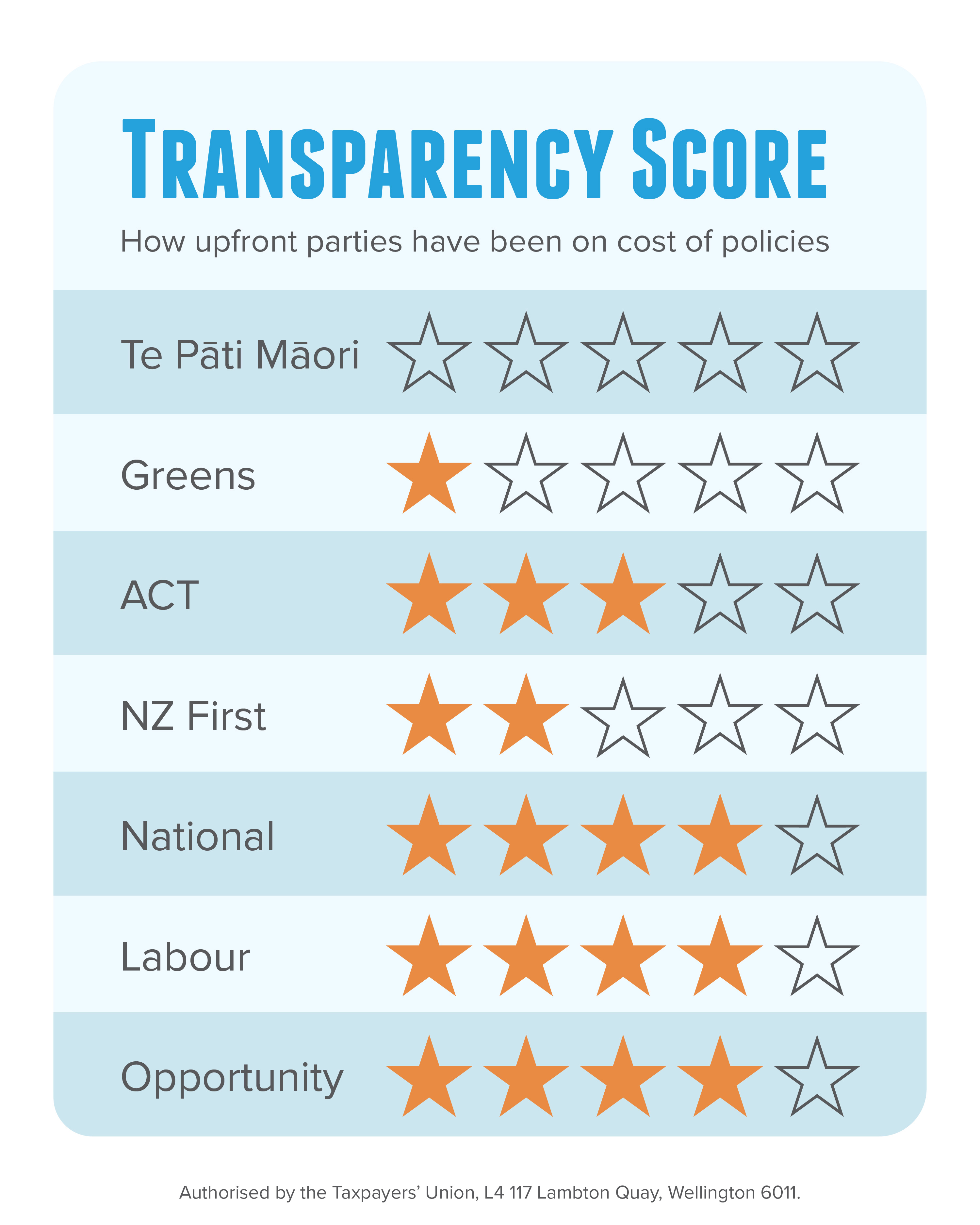
Transparency Rating
As part of the Bribe-O-Meter, our economic staff have assessed political party's transparency across policy detail and cost and given each a score out of five (see below). The most transparent party has been National. For having no costed policy, the least transparent are Te Pāti Māori. These are closely followed by the Greens.
Bribe-O-Meter Week 1: Tracking the Cost of This Year's Election Promises
For the first Bribe-O-Meter update of this election campaign, we've put together the manifesto costings for each of the main parties, and the election campaign announcements so far, so voters can start to see what the parties are promising to spend, and what it will cost taxpayers.
Each week between now and the election on 7 November, we will update the Bribe-O-Meter. So keep checking back every Wednesday to see what new policies have been announced over the week before, and how the running totals for each party are shaping up.
Consistent with previous election Bribe-O-Meters, the figures assume each party spends what it has promised, and do not account for the tax changes some parties have also proposed. Nor does it try to guess what policies might change once governing/coalition arrangements are negotiated after the election.
Something not quite right? Tell us!
One of the objectives of the Bribe-O-Meter is to encourage politicians and parties to be more transparent about the details of their policies and the cost implications. We strongly encourage engagement and public clarification of policy and costing assumptions that sit behind their manifestos. Email us via [email protected] if you spot an error or want to chat to us about what sits behind any particular numbers. We might not always agree, but we certainly want to hear, understand, and (where possible) disclose the different assumptions.
Support us in spreading the word — and educating voters on what this year's election policies cost
Elections are expensive — that's why we've worked hard to create this year's Bribe-O-Meter.
Help us spread the word with targeted Facebook advertising of the Bribe-O-Meter so that more New Zealanders learn what the election bribes will cost them as taxpayers. You can make a confidential donation here. Thank you for your support.
FAQ
What is the methodology and how is the information displayed?
The Bribe-O-Meter compiles the political promises of each of the main political parties and places them within the major spending portfolios.
It assumes that a party elected on 7 November will last for a full three-year term and can fully enact their policy agenda. Policies announced that do not come into effect during the next Parliament will not be included in the figures.
Given that the purpose of the Bribe-O-Meter is to track spending pledges announced by politicians, it does not model the effect of tax cuts or tax increases and the effect they have on households.
Tax credits and rebates have been considered as constituting new spending.
Will you work with political parties to correct or refine the numbers?
Absolutely! We want to provide the public and media with as much information as possible. If there are errors or a party disagrees with our assessment of their costings, we hope that the Bribe-O-Meter will encourage the parties to provide the public with more information and transparency.
How have you costed each policy?
For some policies, we have taken parties at their word. For uncosted policies, we have calculated the figures ourselves. And in some cases, where parties' costings are just unbelievable, we have offered alternative costings. Explainers for each can be found at www.taxpayers.org.nz/bribe_o_meter_workings.
How often will the Bribe-O-Meter be updated?
The Bribe-O-Meter will be updated on a weekly basis, with updates published every Wednesday between now and the election.
Are the graphics free to use?
Yes, the graphics are free to use, but we ask that they are attributed to the New Zealand Taxpayers' Union.
Why do some parties' bars go beneath zero on the Bribe-O-Meter?
When a party's savings in a category outweigh its costs, that category nets negative. The clearest way to represent this on the graph is to have the category sit below zero.