Hi,
The silly season officially starts when Parliament rises next week for the election.
So rather than just moan about all the "bad" things politicians are promising, we've set out the "good" in what we're calling our Taxpayer Manifesto - a set of policies to set our country on course for a more prosperous, transparent (and fairer) future.
This week, we also updated the Bribe-O-Meter with last week's spending promises, and taken a look at some of the increasingly bonkers creative ideas politicians have for "fixing" supermarkets.
We’ve also got a new guide on how to shrink the bureaucracy (withoutpaying $50,000 every time someone leaves!), an update on the campaign to hold MBIE’s boss accountable, and a local government Bill that still leaves far too much power in the hands of council officials.
Let’s get into it.
Taxpayer Manifesto: five things the Government owes taxpayers 📜💸

The starting point for this election's Taxpayers' Manifesto is pretty grim.
Government is spending more than it collects, New Zealand has not recorded a Budget surplus since 2019, isn't forecast to until the next decade and every Kiwi household now carries about $140,000 of government debt. 💸
Servicing Wellington's debt alone now costs the average household $4,904 a year.
None of that happened by accident. It is the result of choices made by successive governments – and fixing it will require some pretty deliberate choices too.
So our manifesto sets out five key priorities:
-
Stop taxing New Zealanders more
-
Cut waste and balance the books
-
Make government answer to taxpayers
-
Put local councils back in their lane
-
Let New Zealand(ers) build and grow
Under those headings are the practical reforms we push for everyday of the week: No New Taxes, ending bracket creep, cutting the public service back to 2017 levels, opening the books on government spending, capping rates, restoring property rights, and putting a proper price on red tape.
The point is not to produce another election wish list.
It is to give taxpayers a checklist against which every party can be judged during the campaign - and, after 7 November, a set of expectations for whoever ends up around the coalition table.
Read the full Taxpayer Manifesto here.
Of course, while we have been setting out what we think the next Government should do, the parties have been busy telling us what theywant to do with your money...
Bribe-O-Meter Week 2: the spending keeps coming 💸📊
Week two of the Bribe-O-Meter is in, and the big movers are Labour and Opportunity - each managing to find another few hundred million dollars of taxpayer your money to pledge to something!
Labour added $421 million of new commitments this week – mostly through its KiwiSaver changes, plus a new Office of AI and a rather Orwellian sounding "Online Safety Regulator".
That is another $203 per household onto Labour’s bill.
Opportunity was only just behind, adding $407 million, or $196 per household, through its new Industry Energy Resilience Fund.
But the more positive news this week is that the parties are engaging and clarifying policies (and therefore costs) to improve the Bribe-O-Meter.
The biggest move was from ACT. Their policy team got in touch to explain that its Pharmac commitment would be funded from savings they've identified elsewhere in the health budget.
Fair enough.
So we took $1.9 billion off ACT’s running (net) total, leaving it with the lowest spending promises of the parties listed.
That is exactly the sort of transparency the Bribe-O-Meter is meant to encourage.
If a party thinks we have misunderstood or overcosted something, show us the how, the why, and the workings – we'll be happy to update it.
Which brings us, once again, to the Greens...
After much toing and froing, their KiwiMart figures still don't stack up.
On the one hand Chlöe Swarbrick says that the Kiwimart costings come from the Parliamentary Library. But despite repeated requests from both the Taxpayers' Union and the media, she is hiding behind Parliamentary secrecy and refusing to share them!
So one party fronts up and gets $1.9 billion taken off its bill. Another refuses to show its working.
You can probably guess which approach we prefer...
Nicola Willis shuts the door on asset sales 🚪💰

Nicola Willis has now gone further than National had previously gone on asset sales.
But not the way many would have hoped!
Asked in Parliament this week whether she would rule out any asset sales for as long as she is Finance Minister, her answer was simply: “Yes.”
That is a pretty big call given where the Government’s books are.
As tracked in realtime on our online Fiscal Reality Dashboard, bond yields have been climbing, credit-rating agencies have put New Zealand on negative outlook, and the cost of servicing our growing debt pile is becoming impossible to ignore.
The short point is that New Zealand needs to have serious conversations about the hard choices involved in getting the books back under control.
That does not mean flogging everything the Government owns. But it does mean asking some basic questions: is taxpayers’ money tied up in things like airlines, dairy farms, and even an ISP doing more good than it could be doing elsewhere?
Our pre-budget Pathway to Surplus paper called for poor or negative-return Crown assets to be assessed for sale, with the capital recycled into better infrastructure or used to reduce debt.
And in Back to Black, we identified $104.49 billion of possible asset sales alongside $59.29 billion of spending savings across the forecast period.
The purpose was not to make the balance sheet smaller for the sake of it. It was to pay down debt and cut the interest bill taxpayers are stuck with unless we change course.
Reasonable minds can differ on precisely what and how much in assets should be sold. But ruling out the whole conversation is exactly the sort of politics that makes fixing the books harder, and will ultimately make us all poorer.
Because the longer we put off the tough choices, the more even harder ones will be forced upon us.
We know a lot of politicians read this newsletter, so we'll make the point plain and simple:
The Government is borrowing 81 million dollars per day. The interest costs are ballooning. The party cannot continue. Tick tock, tick tock. 💣
Mind you, while National's Nicola Willis has ruled out selling Crown-owned businesses, she is rather more willing to contemplate forcibly rearranging privately-owned ones...
National wants to split up kiwi-owned Foodstuffs 🛒
National has now put supermarket restructuring squarely on the election agenda.
If the Commission recommends proceeding, National says it would legislate to force the change.
Foodstuffs, unsurprisingly, is not impressed.
The co-operative is arguing that splitting its brands apart would sacrifice efficiencies and could actually push grocery prices up, rather than down.
Nicola Willis has rejected that criticism, suggesting she knows more about their business.
She's arguing that the current structure is unusual, competition remains too weak, and the Government’s analysis shows shoppers would benefit from separation.
There is no doubt New Zealand has a supermarket competition problem. The question is whether politicians forcibly redesigning the businesses already here is the best way to solve it.
The concern is what all this says to the potential new market entrant everyone claims to want.
Imagine you are an overseas supermarket chain looking at whether to invest hundreds of millions of dollars establishing yourself in New Zealand.
You look across the Tasman and see a tiny market at the bottom of the world, extremely difficult council and planning rules, huge start-up costs - and now a Government prepared to decide how an existing supermarket company should be carved up.
That's hardly a flashing neon “invest here” sign.
We say the better long-term test is whether New Zealand can make it easier for new competitors to enter, build stores and challenge the incumbents themselves.
And, mind you, National’s proposal is still rather modest compared with what Labour and the Greens have been suggesting...
Labour wants the Commerce Commission to police “excessive” prices 🛒🚨
Not to be outdone by Willis' market-intervention bonanza, Labour this week announced it would make “price gouging” illegal for large companies selling essentials including groceries, fuel, energy, banking, insurance and telecommunications.
Under the policy, the law would try to define when a price becomes “unfair and excessive” (as deemed by some Oracleanalyst at the Commerce Commission) seeing the supplier investigated, taken to court, and required to repay customers.
While it does appear New Zealand has weak competition in groceries, Labour’s wanting to treat the symptom rather than the cause. We say the right answer is to, frankly, get the barriers to competition out of the way (see our comments to media here).
After all, the goal is more competitors, not more politicians and bureaucrats monitoring the supermarket aisles...
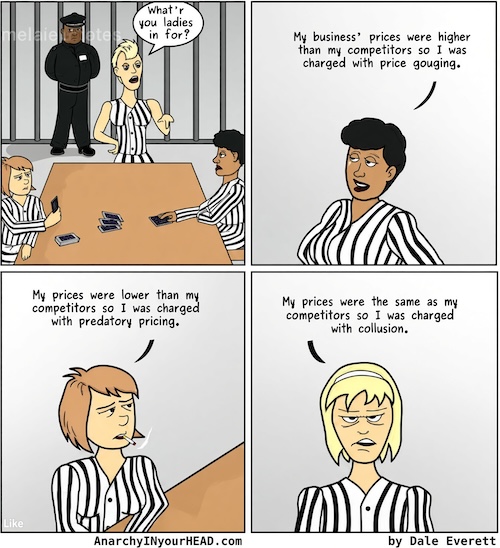
In response to the policy, we quite liked this illustration sent to us by a supporter:
Trimming the fat without writing $50,000 cheques ✂️🏛️

Most agree that the public service is simply too big.
The core public service employed 47,251 people in 2017. It then grew by 18,418 roles, or 39 percent, in just six years.
Even National’s current target of 55,000 would still leave the bureaucracy around 8,000 roles larger than it was in 2017.
So yes, the next Government needs to reduce the headcount.
But how it does that matters too.
Because this week we highlighted a pretty absurd example of what happens when governments leave it too late and rely on expensive redundancies to do the job.
The average redundancy payout for a departing bureaucrat is now $52,500.
That is more than half a year’s average salary simply to remove one role.
Do that thousands of times and taxpayers end up paying another enormous bill just to unwind the bureaucracy they already paid to build.
That is why our Policy Analyst Austin Ellingham-Banks has put together a new guide, Trim the Fat, looking at how the next Government can actually shrink the public service without turning every departure into a five-figure golden goodbye.
The guide looks at using natural attrition, not automatically replacing people who leave, properly managing persistent underperformance, consolidating duplicated functions, and forcing agencies to justify whether vacant roles actually need filling in the first place.
The goal is not simply fewer bureaucrats. It is a smaller, better-run public service, achieved without wasting another fortune getting there.
Read Austin's Trim the Fat guide here.
New poll: voters want MBIE boss who lied to Parliament to go 🚨
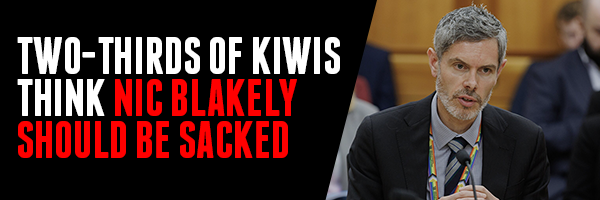
The pressure on MBIE's "Parliamentary-pinocchio" Chief Executive Nic Blakeley continues to build.
As part of this month's Taxpayers' Union-Curia Poll voters were asked whether a public servant boss who agency deliberately misleads Parliament lose their job?
The answer was emphatic: 67 percent said yes, and just 9 percent said no.
You can read the Herald’s coverage here.
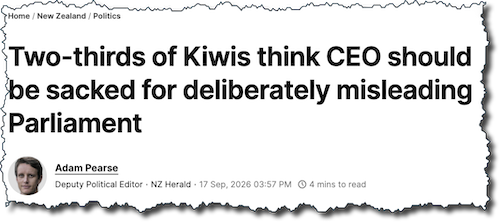
Nearly 10,000 taxpayers have signed our petition calling for Blakeley to go.
If you have not added your name, sign the petition for public sector accountability at BlakeleyMustGo.nz.
Have you registered for our West Coast-Tasman debate? 🗳️

After a great first debate in Wellington Bays on Tuesday (watch on the NZ Herald site here), we’re heading out on the road with our election debate series - and our next stop is Greymouth, where Labour and National are fighting over the vacant West Coast-Tasman seat.
Get your $10 ticket now - free drink included!
After Greymouth we’re heading to Waitaki, then up to Mt Albert, Tukituki, Auckland Central and Tāmaki. I’ll see you there :)
Have a great weekend!
 |
|


