Taxpayer Update: OT has more staff than kids 🤯 | $32m climate crusade at prisons 💸 | 1News hides the emails 📺
Dear Supporter,
While the media would have voters believe the Government's budget was all about 'cuts', this week we explore how the debt continues to climb.
We also highlight the hypocrisy of Television New Zealand demanding "transparency from everyone but moi", and the Dame who says Kiwis aren't paying enough tax (a bit rich from the woman chairing Air NZ, reliant on Government bailouts!).
We also uncover $32 million (and counting) on initiatives by the Department of Corrections to fight crime climate change! Plus the Christchurch ratepayers funding of a $7.7 million non-app. 💸
But first, we’re going to start with something that blew up on our social media last week...
EXPOSED: Oranga Tamariki has 815 more staff than children in its care 🤯

Yes, really.
That works out to around 1.2 staff and contractors for every child.
Now, no one expects social work to be easy. These are some of New Zealand’s most vulnerable children, and the work is serious.
But when an agency has more staff than the number of kids it is meant to be looking after, taxpayers are entitled to ask: what exactly is going on?
Because despite all that staffing, the answers we received under the Official Information Act were alarming:
In December 2025, 32 children aged 6 to 16 and under OT’s care were not enrolled in a school, while 510 records could not even be matched to a school enrolment.
That is children falling through the cracks.
And it’s getting worse, not better. Oranga Tamariki now has 1,512 more staff than in 2017, yet vulnerable kids are still going missing in OT's systems and are not even being tracked to ensure they enrol in school.
Call us pedantic, but this many staff, keeping children safe and enrolled in education should be the bare minimum.
The answer cannot always be more money, more staff, and more bureaucracy.
At some point, taxpayers have to ask whether Oranga Tamariki is focused on children, or on growing the bureaucracy around them.
Budget in brief: better, yes - but make no mistake the debt clock is still ticking ⏰
Would we have preferred more? Of course. Would we have preferred sooner? Absolutely. But Minister Willis deserves credit for finally being honest with New Zealanders about the very real fiscal challenges our country faces.
There is, however, a very big catch.
We were barely back from the Budget briefing when Chief Policy Wonk James was poring over the detail and noticed something didn’t add up.
Even with a surplus in 2030, and even with Willis's savings, Government debt will continue to climb at an alarming rate.

By 2030, your household’s share of Government debt is set to hit $162,000. Under Grant Robertson’s last full year as Finance Minister, it was $116,000. Back in 2008, it was just $29,000.
So while getting back to surplus matters, it does not mean the debt problem has gone away.
Q: Why is debt still rising? 🔺
A: Because so-called 'savings' have just shifted spending around 💳 ↔️ 💳
The Government is shifting more spending into “capital spending” – that’s roads, rail, hospitals, and infrastructure. It's certainly better than spraying money at bureaucracy, but spending is still spending – and it still has to be borrowed.
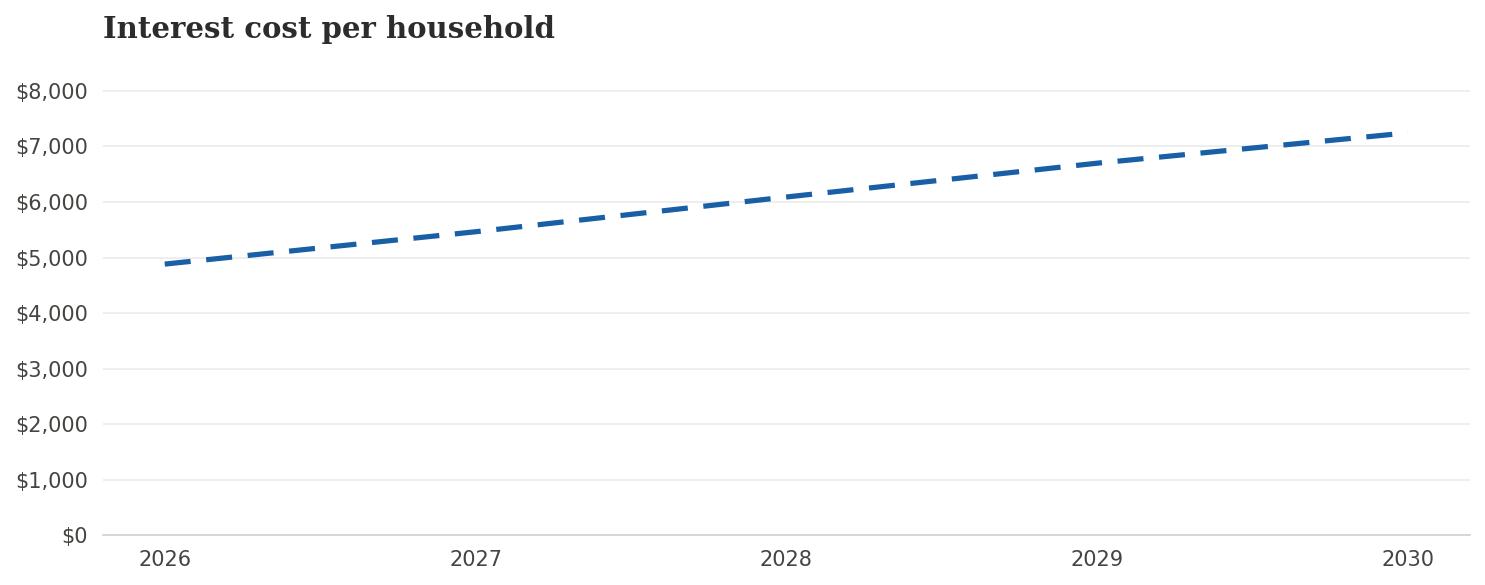
According to the Treasury's projections (released with this year's Budget) between now and 2030, another $21,000 per household is forecast to go on the taxpayer credit card.
By then, the interest bill alone will be around $7,000 per household per year.
That's more than the amount forecast to be spent on primary and secondary schools, Police, and the Ministry of Justice (the courts etc) combined.
The debt clock keeps ticking – and it is our kids and grandkids who will pay the price.
Yes, this was more restrained than it could have been. No, there was no massive election-year lolly scramble.
But every time the books are opened, the Government is still borrowing more.
Taxpayer Post-Budget Briefing on Government Debt 🤓
Our Policy Head, James Ross has dug into the numbers in more detail over on our website, including why a surplus is not enough, why infrastructure spending while welcome still needs scrutiny, and (most importantly) what options the Government has to stop running the country on the credit card.
You can read James' briefing here.
The question now is whether Nicola Willis has the political will to go further if her Government is returned in November.
Corrections’ $32 million carbon-neutral crusade 🚗💸

You might think the Department of Corrections’ job is to keep criminals behind bars, rehabilitate offenders, and keep the public safe.
Silly you.
This week, we revealed that since 2021, Corrections has spent $32,478,300 chasing the Carbon Neutral targets set by the Government.
That includes buying 327 electric vehicles, supported by 352 newly installed chargers, and a further $369,150 on "emissions inventories" (i.e. climate bookkeeping).
Apparently, it also needs to spend tens of millions worrying about things like decarbonising its sheep farm.
The real kicker is that Corrections still did not meet its 2025 emissions reduction targets, and remains uncertain about meeting its 2030 target.
So taxpayers are out $32 million, the targets still are not being met, and the agency is left chasing a climate target that does not need to exist in the first place.
Here is why: New Zealand already has an Emissions Trading Scheme that caps the country's total emissions. That means for every tonne of carbon emissions saved by Corrections, it frees up another tonne to be emitted elsewhere in the economy.
Spending millions chasing separate carbon-neutral targets does not cut overall emissions by a single gram, it just shuffles costs around the public sector and gives bureaucrats another reporting exercise.
The Government looked at scrapping these Government departmental targets back in 2023. These figures show it should stop looking and finally pull the plug.
Dame Therese has found the problem: taxpayers aren’t paying enough 🙄
So, to recap: Corrections can blow $32 million chasing carbon-neutral targets it still does not meet, but apparently the real problem is that New Zealanders are not paying enough tax. That's according to Dame Therese Walsh who chairs Air New Zealand and the ASB Bank.
Speaking to Radio NZ's "30 with Guyon" Walsh suggested that New Zealand needs a tax system better at "picking people up" and is personally "happy to pay a higher tax rate because I earn more than the average Kiwi”, going on to say "I think I should contribute more, and that's what I'm happy to do.”
How generous.
Dame Therese’s ‘offer' might sound noble in a lefty radio studio, but there is already a very simple way for anyone who feels under-taxed to contribute more: make a voluntary donation to the IRD.

We are sick to the back teeth of "business leaders" taking cheap PR positions to virtue-signal. Real leadership would see Dame Therese make the case that free markets, competition, and higher productivity is what gets any country ahead.
But then that's not what Dame's industries (Air NZ and banking) are all about... Maybe not the poster child for competition, and not sucking up to politicians for handouts (i.e. bailouts).
I don’t need to tell you that higher taxes do not create prosperity. They do not fix wasteful spending. They do not make government more efficient. They simply take more from the people who earned it and hand more power to politicians and bureaucrats. Just take a look at local councils...
If Dame Therese wants to pay more tax, she is welcome to go right ahead.
TVNZ wants public money, but not public scrutiny 📺🕵️
Speaking of bizarre expectations...
On Thursday, The Post splashed that TVNZ has withheld emails and documents related to the departure of former political editor Maiki Sherman.

Now, we do not need to re-litigate every twist and turn of the Maiki Sherman saga here. Plenty of ink has already been spilled on that one.
But there is a much bigger issue for taxpayers: TVNZ is publicly owned, publicly funded, and expected to provide public-interest journalism. That means it should not get to behave like a private club when legitimate questions are asked about how it handled a major newsroom controversy.
This is the same TVNZ that sends reporters out every day to demand answers from politicians, public agencies, councils, and ministers, and quite right too.
But if TVNZ expects others to front up, it should be prepared to do the same when the questions are pointed at itself.
 No one is asking for private employment details to be sprayed around for sport. But taxpayers are entitled to know whether a publicly owned broadcaster handled a serious issue properly, whether public money was involved, and whether its internal processes matched the standards it demands from others.
The rule, to me, is simple: if taxpayers fund it, taxpayers deserve accountability.
And for the Taxpayers' Union, the issue isn't about some bigoted comments in a Minister's office. It's whether TVNZ executives tried to cover-up bad behaviour and use public money to gag other (private) media companies from covering a story which was clearly in the public interest.
TVNZ cannot spend its weekdays demanding transparency from Wellington, then hide behind the curtains when the spotlight turns around.
Christchurch Council’s $7.7 million app that wasn’t 📱💸

I’m no tech expert, but even I know there is a fairly important difference between an app and a website.
Apparently that distinction got a bit blurry at Christchurch City Council.
Councillors thought they were getting an app.
What has launched is not a downloadable native app, but a website where residents can view rates invoices, make payments, set up direct debits, pay dog registrations and excess water rates, and lodge service requests.
Useful? Sure.
But $7.7 million for a platform that does not yet integrate the library's website, cannot yet take bookings for council sport and recreation facilities, has only been soft-launched, and is reportedly difficult to even find on the Council’s own website?
Come on.
Back in February, Councillor Sam MacDonald said he “could not be more clear” that the Council would not launch the software unless it was an app.
Since then, he says he was “talked off the ledge” by staff because turning it into an actual app would delay the project even further.
Which sort of begs the question: if councillors thought they were funding an app, and staff knew they were not delivering one, who exactly was in charge here?
And that is the real problem.
Not just that Christchurch ratepayers have forked out the equivalent of 1,962 households’ worth of rates for a very expensive website. It is that elected representatives appear to have been left playing catch-up on a project they were meant to be overseeing.
Councillors are supposed to scrutinise spending, not discover after the fact what they have actually bought.
Council officials need to come clean on where the money went, why councillors were left thinking they were funding an app, and how a digital platform managed to swallow millions before residents even got the thing their elected representatives thought was being built.
Ratepayers deserve better than bureaucrats pulling the wool over the eyes of the people elected to hold them accountable.
$180 million to answer questions Government should already be answering 🕵️♂️
And while we are on the topic of publicly funded outfits being allergic to sunlight...
At first glance, Wellington will no doubt treat this as proof that too many people are asking too many questions.
But the real story is the opposite: this is the cost of government secrecy.
As our Comms Officer Tyler put it, the cheapest OIA request is the one that never needs to be made because the information is already public.
Much of the information people ask for under the OIA is not top secret. It is basic government material: reports, spending data, procurement information, briefings, and documents taxpayers have already paid for.

Instead of publishing it as a matter of course, agencies force journalists, researchers, campaigners, and members of the public through a slow, expensive, bureaucratic obstacle course — only to release much of it anyway.
And then, blow me down, they complain the obstacle course costs too much.
Governments in the United Kingdom, Ukraine, Brazil, and many states in the US publish spending and procurement data online by default. That means taxpayers can scrutinise government spending without having to beg officials for permission or carry the cost of freedom of information requests (and bureaucratic vetting!)
New Zealand should do the same.
An “armchair audit” approach, where routine spending data is proactively published through a central transparency portal, would cut OIA costs, strengthen accountability, and help restore public trust.
The answer is not to make it harder for taxpayers to ask questions; it is for Government to stop hiding so much in the first place.
Ratepayer victory: voting rights are for elected members only 🗳️🎉
And that brings us to some good news: after years of campaigning, Parliament is finally moving to restore a bit of common sense to council decision-making.
In case you missed it, we had a major policy victory this week: after years of campaigning, the Government finally moved to stop councils handing voting power to unelected appointees.
An amendment to the Local Government (Systems Improvements) Bill will restrict voting rights on council committees to elected members only.
In plain English, if you are voting on rates, spending, borrowing, or council policy, you should first have to earn that right from voters.
Frankly, that should never have been controversial.
This was never about race, age, or who councils choose to hear from. It was about democratic accountability: no taxation without representation.
We lost that battle in Tauranga, but we said at the time we had not lost the war.
This week proves it.
Credit where it is due to ACT MP Cameron Luxton, who helped force the issue onto Parliament’s agenda, and to Local Government Minister Simon Watts for finally acting.
But the job is not quite finished. If Parliament can amend the Bill to protect voting rights, it can also amend it to guarantee elected councillors the right to access the information they need to scrutinise spending, challenge officials, and represent their communities.
Victories like this are only possible thanks to our most generous supporters. As ever, thank you.
Enjoy the rest of your Sunday.
 |
|

P.S. Victories like booting off unelected members of council committees do not happen by accident. They happen because supporters like you give us the ability to campaign, expose, embarrass, and keep going even when councils hope we (and the public) will quietly move on. Thank you for making it all possible.
In the Media:
Newsroom Govt agencies spend over $180m on official information requests, report claims
Whakatane Beacon Science funding should focus on practical issues
Bassett, Brash & Hide JOHN RAINE: Our Culture - Can National Learn from Australia or the U.K. in Election Year?
The Press TVNZ withholds emails, documents related to ex-political editor Maiki Sherman
The Spinoff NZ First is a sanctuary. But which parties have its current and future MPs fled from?
The Platform SM won’t report this: poll proves mining is actually approved by Kiwis
BusinessDesk Thoughts on the lobbying debate
Interest.co.nz Can AI help Nicola Willis to cut public expenditure?
Stuff.co.nz ‘Wellington created a monster': What do people make of Wayne Brown's governing style?
Q+A Return to surplus? Nicola Willis charts economic recovery
The Post IRD fired 72 staff for accessing taxpayer records - but victims were never told
The Platform Taxpayer's Union On why This Budget won’t Make Things Better
RNZ The deliberately boring election-year Budget
Three Gals One Beehive The Livin’ on a Prayer Budget
Not PC Responsible? They lie to you and assume you're too stupid to notice.
Newstalk ZB Ruth Richardson: Former Finance Minister and Taxpayers' Union Chair unpacks Budget 2026
RNZ Budget 2026
The Platform Our Debt Problem, Our Spending Problem, Today’s Budget
Newstalk ZB Full Show Podcast: 28 May 2026
ThreeNews ThreeNews 6pm - Item 1
RNZ The Panel with Michael Moynahan and Sue Bradford, Part 1
Pundit Budget 2026: What's best today and tomorrow? It's your choice now
The Spinoff Budget 2026: The great Spinoff hot-take roundtable
Newstalk ZB Full Show Podcast: 27 May 2026
ThreeNews ThreeNews 6pm - Item 7
Stuff WATCH: Auckland Council signs off on massive average rates hike of nearly 8%
RNZ The Panel with Anna Rawhiti-Connell and Phil O'Reilly, Part 1
RNZ Midday Report Essentials for Wednesday 27 May 2026
RNZ Calls to review MPs' perks
Newstalk ZB Morning Edition: 27 May 2026
One News Breakfast Auckland Mayor on rates increase being voted through
Newstalk ZB Full Show Podcast: 26 May 2026
Newstalk ZB Wayne Brown: Auckland mayor addresses planned rates increase for the city
Manawatu Standard Texts to the editor
The Post ‘Shut up, fool': Auckland councillors clash over vote on historic 7.9% rates rise
Newsroom Nerves on edge as Auckland Council finalises record rate rise in cost of living crisis
Stuff.co.nz Former Labour minister Stuart Nash confirms political comeback with NZ First bid
The Post Death by 8700 cuts: Can Wellington survive the great public service cull?
whatsoninvers.nz FENZ Truck Crisis 'worse Than Officials Admit', Inquiry Hears
NZ Herald Labour’s Ginny Andersen challenges Erica Stanford’s education overhaul
The Post Budget 2026: With an economy in trouble, Nicola Willis needs to deliver a conviction Budget
The Platform Wellington’s Woes Multiply The Latest Concerns & Causes
The Platform Jordan Williams From Taxpayers’ Union On Cuts To Public Service
Newstalk ZB Full Show Podcast: 21 May 2026
RNZ MPs told investigation needed into state of fire truck fleet
RNZ Public sector cuts ignite election fight
Manawatu Standard Texts to the editor