Dear Supporter,
A mixed bag this week. On Sunday National recommitted to no new taxes (yay!), ACT unveiled its plan to put Parliament back in charge (stop courts stepping over the line), Labour released its, errr, "fiscal strategy" (i.e. even bigger government) and we had a major win on capping council rates.
Let's get into it.
POLICY VICTORY: National commits to “no new taxes” 💸

If you missed Jordan's email last Sunday, we've had a major victory.
After Nicola Willis appeared to water National’s position down to “no new taxes on working people”, we pushed back hard.
Thousands of Taxpayers’ Union supporters contacted National MPs and candidates asking them to commit to 'No New Taxes'.
On Sunday, Christopher Luxon and Nicola Willis did exactly that, recommitting National to a clean “no new taxes” pledge and ruling out both an accommodation levy and a bank tax. 🙌
That is a genuine win for taxpayers, and credit to National for listening.
You can read my full comments on National’s U-turn here.
Of course, the hard part now is making the books balance without reaching for new taxes. That means spending restraint, not clever new labels for old-fashioned tax hikes.
And speaking of taxpayer pressure actually working, this was not the only policy win of the week. 🙂
POLICY VICTORY: Rates Caps are coming 🧢🪧

This one has been a long time coming.
In June last year, we launched our Cap Rates Now campaign at Fieldays after years of double-digit rate hikes and council spending running well ahead of inflation.
Our proposal was simple: cap annual rates increases, with councils forced to get ratepayers’ approval if they wanted to go higher.
We took the message to the Local Government New Zealand conference, where Simon Watts promised a rates cap was coming.
Then, when officials and council lobbyists started arguing over how watered-down the policy should be, we published our own How to Cap Rates Now blueprint setting out what a serious cap should look like.
By December, the Government accepted the central argument: councils cannot simply keep reaching deeper into ratepayers’ pockets every year.
That is a major policy victory.
We now have the details of the policy announcement from last December, and the Bill has officially been tabled in Parliament.
One more thing, Mr Watts 👀
You may have noticed one important word missing from the Government’s version of Cap Rates Now:
Now.
As drafted, Simon Watts' version of the rates cap won't kick in until 2029.
That gives councils another three years to front-load rates hikes!
We say, why wait? With a simple change to the drafting, and a Parliamentary hurry-up, rates caps could come into effect before councils begin their next Annual or Long-Term Plan process early next year.
There are other fishhooks too. The proposed "rates band" National have proposed appears to risk becoming a rates floor as well as a ceiling!
Also left unanswered is what actually happens if (or should I say, when) a council simply ignores the cap.
Because limiting how much councils can charge is only half the battle.
Thanks to your support, the Cap Rates Now! campaign has won the argument. Now we need to make sure the policy detail is sorted so that it actually works.
And with the likes of (ratepayer funded!) anti-ratepayer sock-puppet groups like Local Government New Zealand desperately trying to undermine the policy, we'll be keeping a very close eye on the legislation as it works its way through Parliament.
But at least we're on the right track.
Meanwhile:
Labour’s “only one new tax” promise lasts... one day 💸⏱️

Labour has been trying to reassure voters that its capital gains tax will be the only new tax it introduces.
But to no one’s surprise, that promise lasted, well, less than a day.
Because the very next time Chris Hipkins was behind a microphone, he was promptly promising to change the law so councils could [checks notes] introduce a brand new tax!
Hipkins says a Labour-led Government would change the law to let councils impose a brand new bed tax.
Now, a tax on, say, international visitors is one thing (we already have one of those). But a tax on Kiwis using campgrounds, motor lodges, or hotels to visit relatives or take a summer holiday is quite another.
The International Visitor Levy is forecast to collect $229 million this year, but only $173 million has been allocated for spending.
Before inventing another tax, perhaps politicians could start by using the money they already collect.
As we said when Hipkins first opened the door, his “only one new tax” promise was gone by lunchtime.
Better Starts Now... apparently 😏
There was at least some entertainment to be had from Labour’s new campaign slogan, “Better Starts Now”.
It lent itself to a meme, so naturally this is what our team did with Labour’s new slogan here.
The only problem was that a day later, National's social media team apparently had the same bright idea.
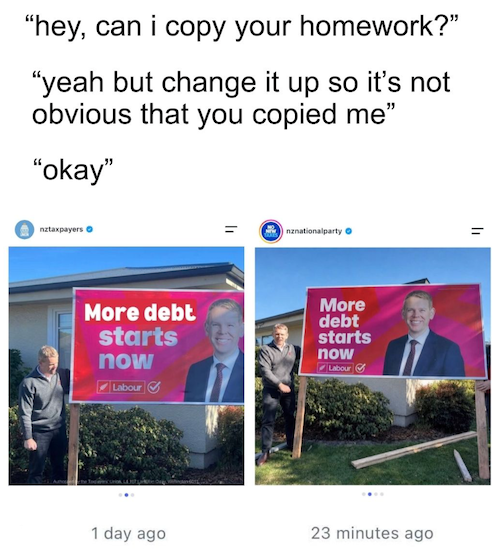
To whoever makes the social media graphics for the National Party, we simply say, 'imitation is the sincerest form of flattery'. 😘
Dear activist judges – ACT wants to put the elected Parliament back in charge ⚖️🏛️🖕🤭

This week, ACT unveiled a constitutional reform package aimed at answering a pretty basic question: Who should make New Zealand’s laws: elected MPs or unelected judges?
The party wants to explicitly affirm parliamentary sovereignty, the rule of law, and equality before the law in the Constitution Act. It also wants property rights added to the Bill of Rights Act and tighter rules around how courts interpret legislation.
The underlying principle is important.
Judges have an essential job interpreting and applying the law. But when courts begin to develop fundamentally new legal duties or make major policy choices, democratic accountability begins to break down.
MPs have to put their names to the laws they pass, defend them publicly, and eventually face voters at the ballot box, but judges quite rightly do not.
Recent Supreme Court decisions have shown how blurred the line can become:
- In Ellis, the Court recognised tikanga as part of New Zealand’s common law and left its development to future cases.
- In Smith v Fonterra, novel climate claims were allowed to continue despite the Court of Appeal concluding they involved economic and social choices better suited to Parliament.
Whatever you think of those individual cases, the constitutional point matters.
If New Zealand is going to create a fundamentally new legal duty, change the rights attached to property, or make some other major policy choice, there should be a Bill, a parliamentary vote, the public should be able to submit, and voters should know who to blame or reward afterwards.
Labour’s fiscal plan: spend big, promise balance, hope the numbers behave 💸📉

This week, Labour set out its fiscal strategy, promising to, in effect, lock in the COVID-spending bonanza permanently.
Under Hipkins, Labour wants to grow core Crown spending to around 33 percent of GDP while somehow getting the books back into surplus on the same timeframe as National.
Here’s the problem: getting Government revenue to 33 percent of GDP by 2031 would require around $10.3 billion ($4,971 per household) a year in additional revenue.
Without new taxes, Chris Hipkins' promises don't add up 😬
Labour’s capital gains tax is forecast to raise just $1.3 billion.
So where does the other $9 billion ($4,344 per household) come from?
Either spending comes down (which Labour has ruled out), your taxes go up, or Labour finds a very large rabbit to pull from the fiscal hat.
But credit where credit is due.
Labour's finance spokesperson, Barbara Edmonds, has ensured that there are some sensible institutional bits in Labour's package. Labour is backing our calls for an independent Parliamentary Budget Office and wants to return to the conventional OBEGAL measure rather than Nicola Willis' OBEGALx fudge (Willis invented this new measure to ignore exclude ACC deficits).
But then Labour, again, blew the fiscal credibility meter to bits with a dopey rerun to excuse higher inflation via shifting the goalposts for the Reserve Bank. 🤦♀️
Labour wants the Reserve Bank to ignore inflation again 🎈

Labour also announced it wants to restore the Reserve Bank’s "dual mandate" asking the Bank to target both inflation and “maximum sustainable employment”.
That comes at the cost of accountability. The Bank should have one job: keeping prices stable.
We've been here before. Grant Robertson ran this policy the last time Labour was in Government.
And we all know what happened: the policy resulted in the cost-of-living crisis we're all still paying for.
Monetary policy cannot sustainably create jobs. What it can do is lose control of prices.
As our Chair, Hon Ruth Richardson (who knows a thing or two about tackling inflation!) put it: when the Reserve Bank has two goals, accountability gets conveniently blurry.

With two mandates, there’s always somewhere else to point the finger – inflation is blamed on employment, and weak employment on inflation.
NZ First also needs a brickbat here. Winston Peters announced a policy of broadening the Bank’s mandate too. 😔
After the dreadful experience of Grant Robertson and Adrian Orr, we should be making the Reserve Bank more accountable for inflation – not giving it another reason to explain it away.
Work and Income NZ’s $236 million bond-grant black hole 🏠💸

Earlier this week, the Taxpayers' Union investigations team revealed that the Ministry of Social Development has no idea how much of the $236 million it handed out in rental bond grants has been recovered.
For background, Work and Income (WINZ) provides rental bond grants to people who can’t afford the upfront cost of moving into a rental. The bond is paid on their behalf, but it isn’t free money – it is recoverable assistance that is expected to be repaid.
When the tenancy ends, you'd expect WINZ to know what happened to the bond and how much of the taxpayer-funded grant was ultimately repaid.
WINZ could tell us how much had been handed out, but to our astonishment, they could not tell us how much had actually been recovered.
To be clear, that doesn't mean $236 million has disappeared. But if the department handing out the money can't tell taxpayers how much came back, that's a pretty extraordinary accountability failure.
Before WINZ hands out the next bond grant, it should be able to answer a pretty basic question about the last one: did taxpayers get their money back?
It's almost as if they don't value our money...
Futureverse goes bust – taxpayers pick up $6 million tab 🐇💸

Here’s something that caught our eye in the NZ Herald late last week.
Futureverse was once touted as one of New Zealand’s great tech success stories.
Haven't we heard that before?
The crypto and metaverse roll-up claimed a billion-dollar valuation, raised tens of millions from private investors, and was even celebrated by government agencies as a Kiwi tech ‘unicorn’.
(A ‘unicorn’, for those fortunate enough not to speak venture capitalist, is a start-up valued at more than $1 billion.)
A few years later, the unicorn is looking rather more like a donkey. Futureverse is now in liquidation with around $40 million in debts and practically no assets left to repay them.
For taxpayers, Callaghan Innovation is owed more than $432,000 from a loan to a Futureverse precursor, while NZ On Air handed Futureverse $5.3 million in game development rebates in 2024 and 2025.
That's close to $6 million of taxpayers' money sunk into a company that collapsed just months after receiving its latest payment.
Sound familiar?
Just last month, we warned that Callaghan Innovation’s mounting loan losses were exactly what happens when bureaucrats try to pick commercial winners with other people’s money.
Futureverse is a pretty good case study. At its peak, it had big-name investors, grand plans for the metaverse, and digital rabbit NFTs changing hands for eye-watering sums. By the time it collapsed, those rabbits had lost almost all their value.
When venture capitalists get it wrong, they lose their own money. When Wellington gets it wrong, you lose yours.
Enjoy the rest of your weekend, and thanks for your support.

 |
|


