Hi,
Today marks three months until the election, and the silly season has well begun. It even snowed in Wellington!
This week, we look at whether NZ First’s $400 million proposed 'baby bonus' is likely to work, expose who in the government is pulling sickies, and why the Nats need to repeat their 2023 "no new taxes" pledge.
But first...
Labour slump, TOP soars, Government coalition clings on in Taxpayers' Union-Curia Poll 📊
With the PM's gaffe in front of a Rotorua business audience last week, and the policy-on-a-hoof MMP referendum yesterday, it's fair to say your humble Taxpayers' Union has been receiving plenty of enquiries asking when this month's Taxpayers' Union-Curia Poll is out...
So here it is: good news for Prime Minister Luxon, and the Opportunity Party.
The standout result is Opportunity breaking through five percent for the first time in a mainstream public political poll.
But it's at Labour's cost. Labour falls to its weakest showing since December 2024.
Te Pāti Māori, meanwhile, has slumped to almost level with the [double checks notes] Women’s Rights Party.

National is up 0.5 points to 31.0 percent while Labour is down 3.7 points to 27.8 percent. The Greens are down 0.3 points to 10.1 percent, while New Zealand First is down 1.7 points to 9.1 percent. ACT is up 0.4 points to 7.3 percent, Opportunity is on 6.1 percent (+2.8 points), while Te Pāti Māori is down 1.9 points to 1.5 percent.
Converting these results to seats in the Parliament, compared to last month's poll, National gains 1 seat to 40, while Labour drops 5 seats to 36.
The Greens are unchanged on 13, while New Zealand First drops 2 seats to 12.
ACT is unchanged on 9, while Opportunity gains 8 seats to 8. Te Pāti Māori drops 2 to 2 seats.

In terms of the Government and Opposition blocs, it is nearly a tie. 61 seats for the Government, and 59 for the opposition bloc (including Opportunity).

Luxon regains lead in Preferred PM 👔
Christopher Luxon is ahead again in the Preferred Prime Minister score. He's up 4.1 points to 23.2 percent, while Chris Hipkins is up 0.6 points to 19.8 percent.
Winston Peters is down 1.3 points to 10.5 percent, Chlöe Swarbrick is up 0.2 points to 4.8 percent, while David Seymour is down 1.3 points to 3.8 percent.

With just 90 days until the election, the Coalition is hanging on by the narrowest possible margin - and the arrival of a seventh party in Parliament means nobody can afford to feel comfortable.
Winston Peters proposes a $400 million baby shower 👶💸

New Zealand First wants to pay people to have babies.
That means up to $45,000 per family, tax-free and without any income test.
But there is a catch. At least one parent must be a New Zealand citizen.
With New Zealand’s population ageing and the birth rate falling, there is no denying we have a demographic problem. It means fewer workers will be left supporting a growing retired population.
When universal superannuation was established, there were roughly seven workers for every recipient. Today, there are around four. By 2060, that is expected to fall to just two workers supporting each superannuitant.
So Winston Peters is right to be worried.
Do baby bonuses work to increase birth rates? 😏
I'm sorry to report that taxpayers shouldn't be sure of Winston Peters' proposed cure for declining birth rates.
Many, many governments around the world have tried paying people to have kids – some are considerably more generous than what NZ First proposes. But the result hasn't been a permanent baby boom.
Take Poland and Hungary.
Poland offers mums a universal payment equivalent to NZD4,380 per child, per year. And it's paid until the kid turns 18!
Hungary has gone even further, offering generous family tax credits, subsidised loans, and housing assistance. Mothers with three or more children can receive a lifetime exemption from personal income tax, while similar exemptions are being progressively extended to mothers with two children.
Have kids, pay no income tax for the rest of your life - now you're talking!
But even those generous schemes haven't worked.
Both initially coincided with a modest rise in births, but the effect did not last. Fertility rates have since fallen sharply in both countries, suggesting the incentives may have brought some births forward rather than persuaded families to have more children overall.
Generally, the international evidence is that cash incentives can encourage couples to have children sooner but don't appear to increase the overall birthrate. Births briefly rise, the headlines look encouraging, and then the underlying downward trend resumes.
Damn.
So while we welcome NZ First's policy intention, we're not so sure of the value-for-money ($400 million a year is a large bet on a policy that hasn't worked elsewhere).
National has adopted Grant Robertson's 'stealth tax' 📈

Christopher Luxon campaigned on not putting up taxes, and (rightly) pointed out that the last Government's failure to adjust income tax thresholds to match inflation pushed even modest income earners into higher tax brackets.
It's sometimes called "fiscal drag" or "bracket creep". A better name is the "inflation tax". It's the sneaky way Grant Robertson put up tax bills without ever asking Parliament.
This year's budget did nothing to catch up.
So Christopher Luxon's dismissal of offering income tax relief as part of a returned National-led government is one thing, but telling the media that inflation-indexing income tax thresholds as “not on our radar” is a real slap in the face.
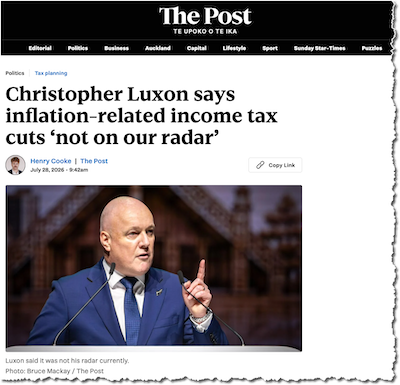
Freezing income tax thresholds while prices and wages continue to rise will mean that National is, in effect, planning to hike taxes just like Grant Robertson did.
For a Party running advertising that it is the 'Party of low taxes', we think Mr Luxon is missing a trick and risks his Party's message not landing with voters.
We say the Nats should rule out new taxes – including those imposed by stealth.
You can read our Briefing Paper here.
New polling suggests Chlöe Swarbrick is in trouble in Auckland Central 🗳️😬
You might have received Jordan's email the other week about considering local electorate debates during this year's election campaign.
As part of that, we asked our pollsters to quietly poll some of the more interesting electorates around the country.
A surprise result was Auckland Central, where incumbent electorate MP Chlöe Swarbrick appears to be five points behind the National Party's Candace Kinser.
We only shared the results with our "Taxpayer Caucus" - our club of our most generous supporters who make the Taxpayers' Union possible.
But, alas, the media got hold of it, so the cat is out of the bag...

Read the Herald’s coverage here.
If you'd like to receive our regular Caucus updates - including other exclusive (insider) polling and political and policy insights we can't share more widely, you can step up your support and join the Taxpayer Caucus here.
SICKIE LEADERBOARD: the public service is getting sicker 😷

As part of our Public Sector Accountability project, we've been asking government agencies how many of their staff are actually coming into the office vs working remotely.
More to come on attendance, but first, we've pulled together the data on sick leave.
And not all is well.
My first reaction was that it is probably COVID – people are less tolerant of sitting next to a snotty colleague since the pandemic.
But the timing doesn't work. Instead, it seems that the numbers have risen sharply since the current Government came into office.
Now perhaps it's entirely coincidental. Maybe the public sector really has become dramatically more sickly. 🤷
Or perhaps a workforce increasingly hostile to the Government is also less enthusiastic about showing up for it.
Sick leave exists for a good reason. Nobody should be coming into work when they are genuinely unwell, and public servants are entitled to the same provisions as everyone else.
But when absence rates keep climbing, taxpayers are entitled to ask whether every department is managing them properly – especially when those same taxpayers are paying for delayed work, lower productivity, and colleagues covering the gap.
Public servants who are genuinely sick should stay home.
But a 26 percent rise in sick leave deserves a diagnosis of its own...
$300,000 for "an area that has seen surprisingly little research"... 🤦♂️

On Wednesday, RNZ reported that taxpayers are funding up to $300,000 of research into (and we're not making this up) whether kapa haka is good for cardiovascular health.
A new research grant to investigate the benefits of kapa haka on heart health, an area that has seen surprisingly little research, has been announced.
The grant, worth up to $300,000, from Pūtahi Manawa, a national Centre of Research Excellence (CoRE) hosted by the University of Auckland, will support a Māori-led research project investigating how kapa haka contributes to cardiovascular health and wellbeing.
The grant, offered through the Pūtahi Manawa "Centre of Research Excellence", will examine the cardiovascular benefits of kapa haka and whether it could help inform future health programmes.
So we are prepared to offer researchers a preliminary hypothesis free of charge:
Kapa haka clearly involves aerobic activity.
Aerobic movement is good for health.
Moving around is probably healthier than sitting on the sofa.
$300,000 is not needed.
If kapa haka encourages people to exercise, strengthens communities, and improves participation in cardiac rehabilitation, that is positive.
But $300,000 to study it?! That's a performance harmful to taxpayers' health.
Still, it's probably better than the $4 million spent on the study playing whale song to kauri trees.
That’s all for today. Have a great weekend!
 |
|


