Hi,
This week, we call out a former Labour COVID-response Minister for (ironically) disinformation, reveal a LEAKED audio recording of the now infamous "MBIE workplace waiata", and fisk the Green Party's proposed wealth tax. Plus we'll brief you on new work by the New Zealand Initiative think tank, asking who's *really* in charge – the elected officials, or the unelected mandarins?
Let's jump in.
The reports of Wellington's death greatly exaggerated – by Wellington MP 🤨

Now we know for some MPs, maths isn't their strong suit, but Labour's MP Ayesha Verrall really stretched the excuse last week in her claim that the reason Wellington's economy is in the dumps is because there have been “thousands of public service job losses".
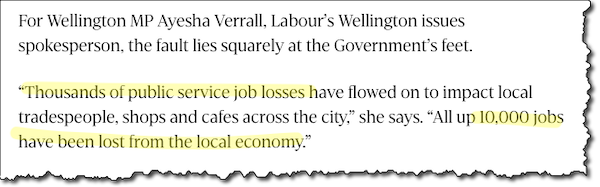
Here at the Taxpayers' Union, we're keen supporters of free speech. Everyone is entitled to opinions – including Ms Verrall – but she's not entitled to her own facts.
Mass layoffs across the bureaucracy is a myth - but still repeated by dishonest confused Opposition MPs 🤪
According to the Public Service Commission (Wellington's "Podium of Truth" for how many people are actually employed by the Government), there were 63,117 public servants in 2023 compared to 63,657 at the end of 2025.
To spell that out for those sitting in Parliament reading this newsletter, that’s 540 more staff on the payroll now than when they were in charge.
Not an option, a fact: More bureaucrats do not amount to "thousands of public service job losses".
Where's Ayesha Verrall's "Disinformation Project" when you need it? 🤷♂️
LEAKED VIDEO: How distracting are MBIE's daily workplace Waiata sessions? 🫨

Earlier in the month, your humble Taxpayers' Union exposed the brouhaha within the Ministry of Business, Innovation, and Employment over management's attempt to reign in the staff 'entitlement' for staff to be paid daily to sing, clap, poi, and recite Māori proverbs and hymns in open spaces at their Wellington office.
To recap: staff claimed that management's request to have the sessions during unpaid breaks was "colonial" and "culturally insensitive".
They said even "relocating to enclosed rooms" (in order to avoid disrupting other staff in the open offices) was "viewed as symbolic marginalisation" and "hiding the kaupapa".
It turns out that among the 200,000 subscribers of this newsletter, many work at MBIE!
Our inbox was flooded with reports that the huge open marble spaces inside the old Defence House (where MBIE is based) echo and reverberate the sound.
And we have some good news! At least one person among MBIE's 5,892 bureaucrats actually wants to get some work done! An MBIE insider whipped out their phone to record – from their desk – just how distracting, sorry, engaging, the workplace waiata sessions are, even for those who don't participate.
We replaced the video so as not to identify our taxpayer-hero embedded within MBIE.
Judge for yourself whether you'd get work done with this in the background...
Make sure you turn on the sound. 🎼
The Greens’ wealth tax fantasy: who really pays? 😱🦄
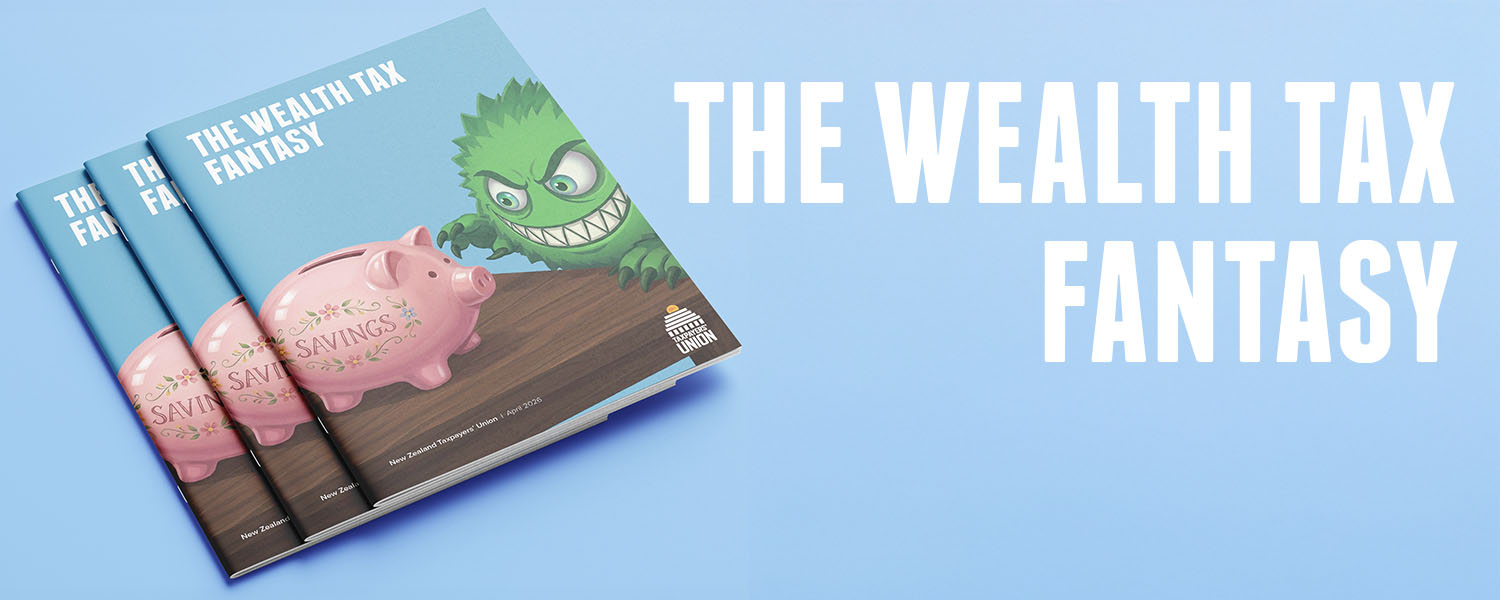
They say their wealth tax will only hit the “top 3 percent”. That sounds neat, a nice soundbite to attract the attention of "freedom-fighting” students and leftie bureaucrats.
The issue is that it’s simply not true.
Based on the latest available data, 6.5 percent of retired couples and 5.5 percent of single retirees are already over the Green's threshold – and that’s before factoring in rising house prices.
And because the threshold isn’t indexed to inflation, more and more Kiwis will be dragged in every year.
The Greens see it as a feature not a bug.
Many around the world have tried, but nearly all have walked away 🇫🇷 🇳🇴 🇨🇺
There’s a reason wealth taxes are rare and disappearing overseas.
Nine out of twelve European countries that tried implementing a wealth tax have scrapped them.
Norway expected to raise more revenue — instead, tens of billions left the country, and the tax take fell.
France saw hundreds of billions flee before abandoning its tax.
Even the NZ Treasury has warned that a tax at the level proposed by the Greens would be “extremely economically costly”. That's Treasury code for nuts.
The Greens claim this tax will raise around $17 billion a year, roughly 12 percent of all government revenue. Per capita, that would make it the most revenue raising wealth tax in the world.
Even Switzerland, the global outlier, raises only a fraction of that share.
So either the Greens have rewritten the laws of economics, or the numbers simply don’t stack up.
Because once you dig into the detail, this is just another tax on anyone who saves, invests, or builds something over time.
👉 Read The Wealth Tax Fantasy paper here 👈
Justice Minister complains that 'freedom of information' too expensive & proposes more secrecy for Government information 🕵️♂️
Most of the information published by the Taxpayers' Union isn't leaked, rather it is obtained using freedom of information laws: the OIA (for central government) and the LGOIMA (for local councils).
So shivers ran down the spines of your investigations team when Newsroom got wind of Justice Minister Paul Goldsmith's review of the Official Information Act late last month.
Apparently, too many people are asking questions of Government agencies and that's a problem! If only.
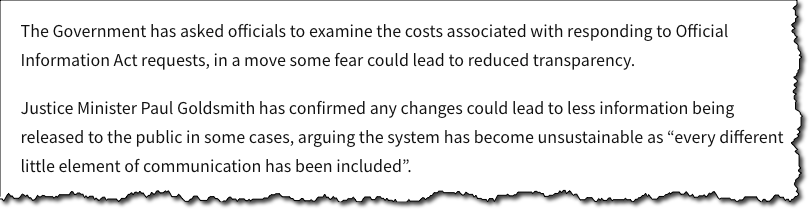
As New Zealand's largest transparency organisation – and the largest user of the Official Information Act – the team were admittedly a bit miffed not to be asked to contribute to the Minister's so-called "review".
We have been assured that it was just an oversight...
Because we actually agree with the Minister that too much is being spent administering OIA requests.
But the fault isn't because people are asking 'too many questions', it's because in recent years, Government agencies have developed a habit of insisting that even most mundane questions or enquiries are treated as formal "Requests for Official Information" under the Acts.
Once upon a time, you could call up a Government agency, get the relevant official on the phone, have a discussion, or send an email and get a response.
Now almost everything is funnelled through "Communications Teams" whose job it is to help "manage" the release of information.
Ironically, the very freedom of information laws designed to make government more transparent are being used to slow down and frustrate the release of basic information in a timely way.
Or, as Rhys put it in a guest post published on Kiwiblog: The law isn’t the problem. Instead, the culture in Wellington and council bureaucracies across the country is causing unnecessary costs.
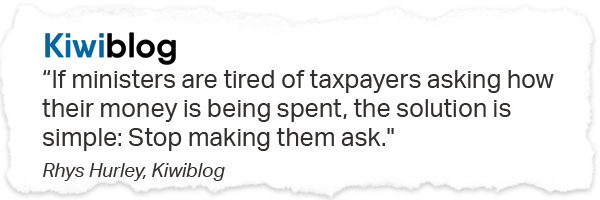
If the Government uses that game playing as an excuse to reduce the rights of taxpayers to know where their money is being spent, it's something taxpayers (and ratepayers) will fight tooth and nail.
Mr Goldsmith, to save money, there are some very simple solutions: proactive release of information and adopting 'armchair audit legislation' requiring all financial transactions by government agencies to be disclosed online (which is common overseas).
Who actually runs the place? Restoring democratic control of New Zealand's public service 🗳️
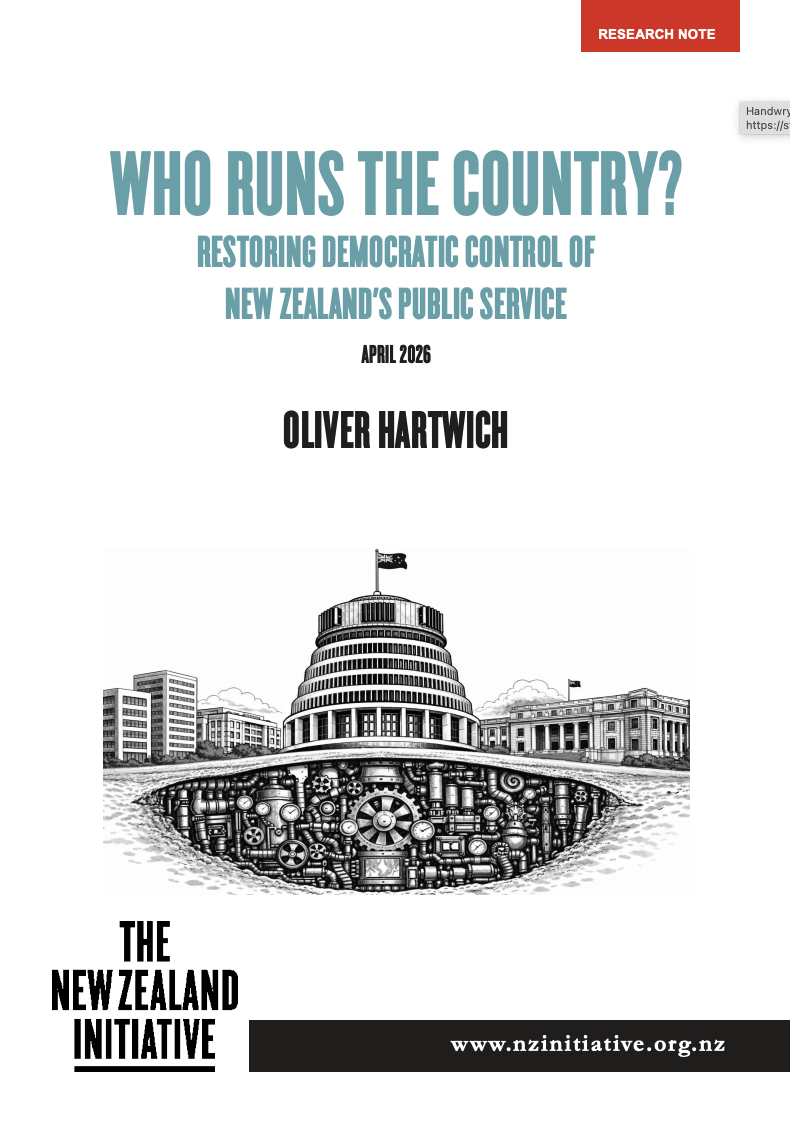 Finally, this week, we want to highlight a really good report by our friends down the road at the New Zealand Initiative think tank, asking whether the unelected bureaucrats with their own incentives, agendas, and policy preferences are running roughshod over the democratically elected will of the people.
Their paper, by Dr Oliver Hartwich, Who runs the country? Restoring democratic control of New Zealand's public service argues that New Zealand’s ministers answer to Parliament for departments they cannot control because ministers cannot choose, direct or remove the chief executives who run those departments.
It's a fascinating (and slightly alarming) look at how decisions really get made in Wellington, but is consistent with the frustrations we regularly hear from MPs and former Ministers (from both sides of the political divide).
It argues that the arrangement is broken and recommends that New Zealand adopt a version of Germany’s model, where ministers appoint their top officials while a protected career service operates below.
Virtually every other developed democracy gives its elected ministers some say over who runs their departments. France, Germany, Italy, Sweden and the United Kingdom all do. New Zealand does not.
Off the back of the paper, Peter Williams interviewed Dr Hartwich to dive in.

If you’ve ever wondered why so many policies get watered down, delayed, or quietly changed along the way… this one will hit close to home.
Listen (audio only) on our website 🎧 or watch the episode on our YouTube channel. 📺
That's all for now.
 |
|