POLICY VICTORY: Minister Louise Upston this week's Taxpayer Hero 🏆

Back in November our Investigations Coordinator, Rhys, uncovered that the Ministry for Social Development had poured more than $38 million into Flexi-Wage Self-Employment support and Business Training and Advice Grants.
These are taxpayer-funded grant schemes that pay beneficiaries to try to start a business — with extra cash for training and advice along the way.
Sounds fair enough, right?
Well…
Rhys found that the Ministry for Social Development hadn't tracked where the money actually went – they couldn't say whether the funds were pocketed or were actually used to start a business.
They did know that hundreds of recipients ended up back on a benefit — and worse still, MSD wasn’t even tracking whether the businesses that did result succeeded or failed.
No tracking, no accountability, no results. Just a blank cheque.
Rhys wrote directly to Minister Louise Upston, demanding answers and this week Minister Upston has committed to tightening the programme and eligibility criteria.
Is it perfect? No. We still think the tracking and reporting needs to be upped. But this win is proof that shining a light on waste works, and that pressure from taxpayers like you can force changes inside the Beehive.
Well done Rhys.
Andrew Little is bringing some sense to Wellington City Council? 📚🤯
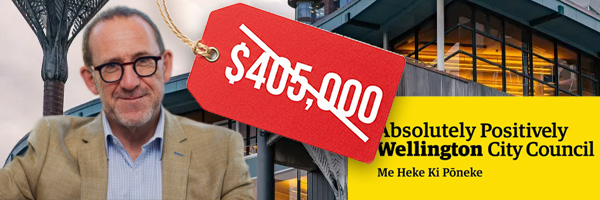
Only in Wellington could opening a library turn into a nearly half-a-million-dollar exercise in excess.
The original plan hatched by Council officials was for a $405,000 opening knees up "ceremony" — yes, really — just to celebrate a building ratepayers have already paid for.
Thankfully, Mayor Andrew Little has stepped in and slashed the budget to $175,000.
But let’s be honest, $175,000 is still a lot of money for an opening.
And it is case-in-point the problem. Despite the financial and infrastructure dire straits the Council faces, officials demand endless extras, bells and whistles, the “wouldn’t it be nice if’s...”. Ultimately it drives higher rates – and in Wellington City's case, a 47 percent hike over the last three years.
Always keen for a party, we’re celebrating the opening in our own way - by sending councillors our 103 Ways to Save Money in Local Government report. 😉
Basement Mayor, Penthouse Bureaucrats: who really runs councils?
As if to demonstrate Wellington (and we’d argue much of the local government sector) as an illustration of the power grab by faceless council bureaucrats and their disdain for voters and their humble elected representatives, the NZ Herald reported this week that tensions are bubbling away inside Wellington City Council over who gets the best digs in its swanky new waterfront HQ.
New Mayor Andrew Little has reportedly been left less than impressed with his modest first-floor office (complete with a view of a car park), while councillors are being herded into shared, lounge-style spaces – hardly befitting those actually elected to run the city.
Meanwhile, the real winners? The council’s senior bureaucrats, who’ve allocated themselves the top floor complete with harbour views and executive comfort.
It might sound trivial — but in one neat office plan, Wellington City Council has managed to physically map its real power structure: the people voters choose are downstairs and out of the way, while the unelected officials call the shots from above.
If you were looking for a symbol of who really runs local government, you’d be hard-pressed to design a better one.
The $450,000 video game NIWA didn’t want you to know about 🎮

Remember when we first exposed NIWA’s taxpayer-funded video game, and officials refused to say how much it cost?
Well, now we know why.
After being pushed all the way to the Ombudsman, NIWA has finally come clean: the so-called “Future Coasts Aotearoa” game carried a price tag of $450,000.
That includes $150,000 paid to an external contractor on top of $300,000 in research costs — a six-figure spend they initially tried to keep hidden behind claims of so-called “commercial sensitivity”.
Now we know what that was.
The contractor wasn’t even selected through a competitive tender! Instead, NIWA handed over the work based on the supplier’s previous “outstanding results”.
In other words: no open process, no competition, no assurance taxpayers got value for money.
As Investigations Coordinator Rhys put it, NIWA had to be dragged kicking and screaming to the Ombudsman before it would reveal how much taxpayer money was really spent.
We loved Heather du Plessis-Allan’s take on the story – describing your humble Taxpayers' Union as "a dog with a wedding dress" once we sniff out profligate spending 😇👇

Tax the rich, or tax everyone? We expose the Green's 'Wealth Tax' 🦠💰
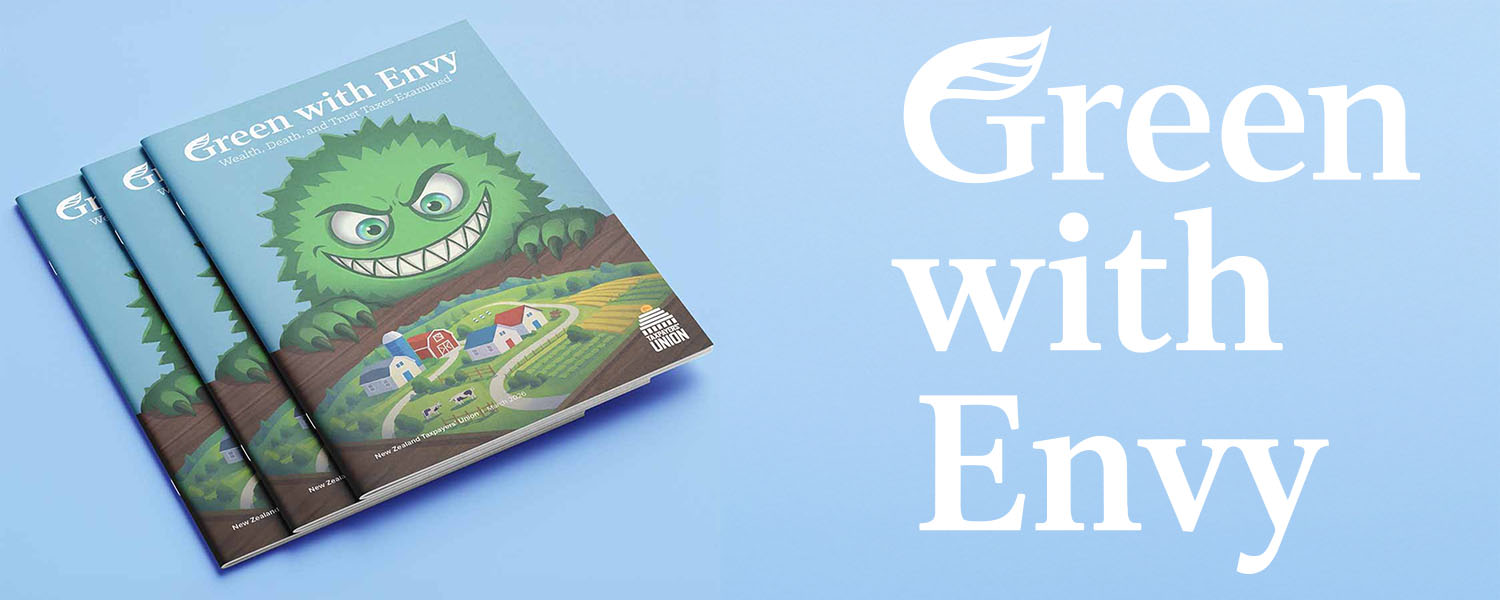
The Green Party says its new tax package is about fairness. But in our latest report, Green With Envy, Policy Analyst Austin demonstrates that what the Green's propose is very different.
Behind the slogans sits a triple tax hit: a wealth tax, a trust tax, and a death tax.
And while it’s pitched at “the wealthy”, the proposal would hammer homeowners, farmers, retirees, and small business owners, while the genuinely wealthy are left with new ways to minimise their exposure.
Let’s be clear: this is a fundamental shift toward taxing not just what you earn… but what you own, what you save, and even what you leave behind. And if the Greens get the chance, this policy is coming for you.
A direct hit on Kiwi farmers (not billionaires) 🚜
Take farmers. The average dairy farm would likely face tens of thousands in annual taxes — even in a loss year.
Worse still, when it’s passed on to the next generation, the tax bill could top $1.2 million, forcing families to sell up just to pay IRD.
Small businesses and home owners cop it too 😰
Small businesses will be penalised for succeeding. Grow your business, and your tax bill grows with it, year after year.
Homeowners aren’t spared. Around one in five homes held in trusts would be hit with a new annual tax — meaning ordinary Kiwi families could be paying thousands more every year just for owning their home.
So much for “taxing the rich”...
The Green's Death Tax 🪦
Perhaps the most jaw-dropping part of the Greens' proposal? It's effectively a 33 percent Death Tax.
That means after a lifetime of earning, saving, and paying tax, the Government takes another third when you pass it on.
While your family grieve, the Greens want the IRD to pinch one third of all assets over $1 million.
That's about the average value of a house in Auckland. So the threshold isn’t “the rich” — it’s many ordinary Kiwi families with a home and a bit of savings.
Green economics don’t stack up 📉
Treasury has warned that wealth taxes at this level are “extremely economically costly” and won’t raise the revenue promised.
Internationally, countries that tried this approach saw investment flee, wealth move offshore and, ultimately, their tax revenue fall.
Or as Treasury bluntly puts it:
“A wealth tax will likely lead some high wealth individuals to leave New Zealand…”
In other words, fewer jobs, less growth, and a smaller pie for everyone.
Australia's black market booms: When tax policy backfires 🇦🇺

In the same way prohibition was a boom for gangs and bootleggers, sky-high tobacco taxes are proving a lucrative money maker for gangs across the Tasman.
According to the Australian Federal Government, Australia’s illicit tobacco market now makes up more than half of total consumption – funnelling up to AUD $6.9 billion to illegal gangs.
As well as taxes (New Zealand and Australia have the highest, income adjusted tobacco taxes in the world), Australia's heavily regulated vaping market has collapsed into near-total illegality — with 95 percent of e-cigarettes sold via the black market.
And it doesn’t stop at lost tax revenue.
Australia is now dealing with gangland violence, including:
- Over 200 arson attacks targeting retailers
- Multiple homicides linked to tobacco turf wars
- Criminal groups using intimidation and firebombings to force shops to sell illegal products
Unlike Australia, New Zealand has taken a more moderate approach to vaping – seeing far more people make the switch to the safer (with an r) alternative.
But now NZ Customs is warning that tobacco smuggling is becoming more sophisticated, more organised, and increasingly dominated by transnational crime groups, so we should be alert.
I don’t smoke, but my cigarette-wielding colleagues reliably inform me that while cigarettes cost $40–$50 a pack. Meanwhile, illegal durries are being sold for as little as $20–$25 and are widely available. The best data available for New Zealand would suggest that about one-in-four cigarettes sold here are illicit.
When the taxman creates that kind of price gap, they don’t eliminate demand, they supercharge the black market.
A disclosure: about three percent of the Taxpayers' Union income is from industry memberships including from the nicotine industry (along with booze, sugar, and other corporates facing industry-specific taxes). We also have individual members who (tut tut) smoke... More information about our funding here.
One poll, total meltdown… but how does polling really work? Peter Williams investigates 📊🎙️

Our latest Taxpayers’ Union–Curia poll sent Wellington into a frenzy at the beginning of March. But in this week’s Taxpayer Talk, Peter Williams sits down with Curia founder (and Taxpayers’ Union co-founder) David Farrar to separate the signal from the spin.
Are polls actually driving political decisions, or just measuring them? And why do politicians pay attention, even when they ignore the results?
David lifts the lid on how polling really works, why the trend matters more than any single headline-grabbing poll, and which numbers actually tell you if a government is in trouble.
It’s a sharp, behind-the-scenes look at the data shaping New Zealand politics — and a reminder that when taxpayers like us speak, even indirectly, politicians do listen.
You can listen here or wherever you get your podcasts 🎧
Have a great weekend!


 After the Royal Commission’s Covid-19 report came out early last week, there was a last-minute nomination and a very clear winner for this year's Big Ham.