Dear supporter,
For a "no new taxes" Government, the politicians in Wellington are sure making it hard to love 'em!
This week, a new string of new taxes, sorry levies, emerged. But it's not all bad news in today's Taxpayer Update.
Let's get into it.
How many times can Wellington tax the same bridge? 🌉💰
It's fair to say our sister group, the Auckland Ratepayers' Alliance is not very happy! 🤬
On top of Wayne Brown's proposed 8 to 10 percent rates hike (the highest ever for the Super City), now Aucklanders are facing the reintroduction of tolling on the Auckland Harbour Bridge.
With the Infrastructure Commission mooting a $9 toll per crossing, commuters could be coughing up $90 per week (i.e. $4,500 per year!) for those on the North Shore to get to work in the City.
We say that tolls are a great idea if they enable new roads and infrastructure. But the principle that tolling should only apply to that new infrastructure (so that it is genuine 'user-pays') should remain.
Tolling the 67-year-old bridge Aucklanders have already paid for isn't fair.
After we pointed out that the toll appears to be another example of the Government breaking the "No New Taxes" pledge, the Beehive reached out to say that that the Harbour Bridge Tax is "just a suggestion" and that Ministers are still "taking advice" before any decisions are made...

But the Ratepayers' Alliance is't waiting. It's called on the Government to stick to its promise and rule out this new Bridge Tax.
You can sign the petition over on the Ratepayers' Alliance's website.

✍️ Sign Petition ✍️
Hate to say we told you so... 🤷♂️
Regular readers will recall your humble Taxpayers' Union warning of the Government wanting to change the law so Ministers can put tolls on existing roads (rather than just new roads) to dig deeper into motorist's pockets.
Back in November, we cautioned against the Government giving the Transport Minister new powers to effectively turn tolling, into taxing:
Tolling works when it's clear drivers pay for what they use. However, the Government's new Parliamentary Bill threatens to stretch this principle by charging drivers for roads they don't use or have already paid for through fuel taxes. It lets the Government clip the ticket twice and use a toll on roadway X to fund maintenance of roadway Y.
We say that asking drivers to pay twice, and funnelling toll road money away from the roads being tolled is just a sneaky way to raise taxes, not improve infrastructure.
With the bubble broken and the ability for politicians to toll any road, don't be surprised if the Auckland Harbour Bridge Tax is just the beginning...
Safe motoring everyone.
Enough of the fiscal fantasyland: Treasury’s brutal fiscal reality check to Willis 🌪️😳

Each to their own, but our chief nerd Head of Policy, James, was very excited to attend the NZ Economics Forum at the University of Waikato last week.
His summary was that the sandwiches were better than the fiscal outlook, so we asked him to write a blog post for our policy-minded friends which you can read here.
TL;DR – here's the lowdown:
While the politicians ducked the questions, one person did cut through the spin: Treasury Secretary Iain Rennie.
Nicola Willis tried to use the event to contrast what she portrayed as her own “fiscal credibility” with Labour’s “fiscal indulgence”. But Rennie delivered a colder dose of reality.
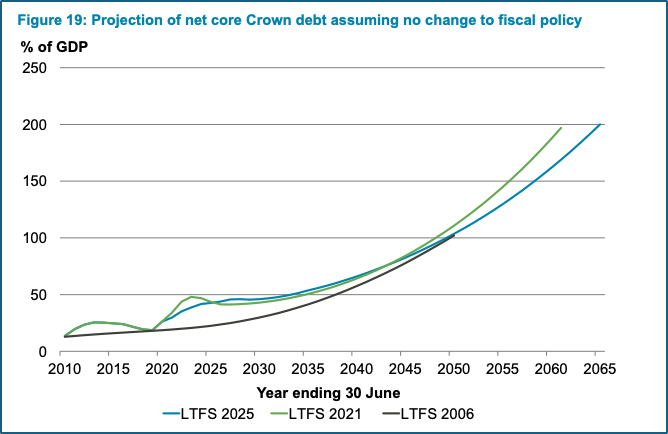
Government debt as a share of the economy has more than doubled since 2018. The buffer we once relied on to weather earthquakes, pandemics, and financial shocks has gone.
And the long-term picture is even worse. The Treasury projections show debt heading toward eye-watering levels by 2060 unless policy settings see major change.
Two themes dominated the discussion: weak productivity and an ageing population.
New Zealand businesses have barely half the capital intensity of the developed world average. Kiwis work long hours, but without investment in machinery, technology, and infrastructure, we simply don’t get the same output for our effort. That has to change.
Then there’s superannuation and welfare. With debt on an unsustainable path, pretending we can fund ever-growing commitments without reform is fantasy economics.
The sobering takeaway was that across the political divide, serious economists agree that we can’t keep kicking the can down the road.
New week, new taxes 🚨
Two year's ago, National’s big election pitch was a promise of discipline. Restraint. And, most importantly: no new taxes.
But, for the third week counting, National Ministers are trampling over it.
First up was the Government’s proposed LNG “levy” - which, in plain English, looks an awful lot like a gas tax slapped onto the electricity system.

Then there’s the rumours of a major tax grab on the banks.

When put to Nicola Willis, the answer was a fudge:
Pushed on whether she was considering slapping big banks with a levy [...] Willis said she wouldn’t play the “rule-in or rule-out game”.
No doubt Ministers might think they can sell a Bank Tax as sticking it to big corporates, but let’s not kid ourselves.
A new tax on banks is a new tax on mortgages. It won't be the banks who pay. Customers will. If you tax banks, you tax borrowing, you tax lending, and you tax home loans.
It might be called a “Bank Tax” but ultimately it'll be baked into interest rates.
And then to join the party, Christopher Luxon appears set to cave in to Wayne Brown and see the previously ruled out accomodation (hotel and Airbnb) tax considered after all...

Levying (taxing) accomodation hits every Kiwi who uses a hotel or book a summer Airbnb or bach.
While Wayne Brown likes to frame his hotel tax as hitting international visitors, actually it hits domestic travellers the hardest. New Zealand already levies international visitors (the Government hiked it to $100 18 months back).
Three weeks, three new taxes. As a National Party member said to me recently: they're making it hard to love 'em....

👏 👏 👏 ACT’s vow to untangle spaghetti government 🍝🏢
ACT’s State of the Nation speech in Christchurch last weekend was a cracker.
David Seymour detailed his Party's plans to cap the number of Ministers at twenty, arguing that New Zealand’s government has become a jumbled mess of overlapping responsibilities, unclear reporting lines, and buck-passing officials.
He's not wrong.
To recap, New Zealand has 81 ministerial portfolios, 28 ministers, and 43 departments.
Having so many responsible intertwined, too often means no one is.
The clearest example is MBIE: one department, yet 20 different ministerial portfolios attached to it.
No wonder accountability is lacking and nothing gets done...
Our friends at the NZ Initiative, a Wellington-based economic think tank, have dived into the detail and demonstrated the complexity.
Compare New Zealand to Norway – a country of a similar population (click for larger version):

This kind of spaghetti structure plays perfectly into the hands of a public service that too often sees democratic oversight as an inconvenience.
One Minister per department would be a major improvement. It would simplify decision-making, clarify responsibility, and put control back where it belongs with elected representatives, and ultimately voters.
Why stop at twenty, David?
While David Seymour's policy is welcome, those with a corporate governance background will know there is strong evidence and a deep literature suggesting that once boards grow beyond around a dozen members, governance effectiveness starts to slip.
Cabinet is no different. We tend to prefer bringing New Zealand into line with the likes of Norway - 10 to 12 Ministers and portfolios.
Claim to fame? 👋
If you're interested in learning more, I recommend the full New Zealand Initiative report Cabinet Congestion: the Growth of a Ministerial Maze by Max Salmon.
Max is a Research Fellow at the NZ Initiative – and started his public policy and advocacy career some years ago as one of the Taxpayers' Union's bright young Researchers. Bravo on this win, Max!
Government borrows millions to play cheerleader for Aussie Rugby League 🏉🐽
The Taxpayers' Union is well known for calling out so-called pork barrelling (wherein politicians deliberately spend money in certain electorates in the hope of influencing electoral outcomes) and corporate welfare. We’ve previously called out Shane Jones’ Regional Infrastructure Fund, and this week we're calling out another boondoggle: the National Party's "Major Events Fund".

Only days after selling “fiscal restraint” at the NZ Economic Forum, the Government announced it is tipping A$5 million into bringing Australia’s State of Origin to Auckland!
That’s A$5 million of borrowed money, for an Australian sporting league.
We didn't mince our words calling this out.
I'm told that State of Origin is a great spectacle, but is creating what amounts to an export subsidy why we pay taxes?
The A$5million amounts to $600 per tourist! And that's if you assume the Government's rosy predictions of the event bringing 10,000 fans across the ditch.
We’re not the fun police. I enjoyed the Hurricanes match in Wellington last night. If an event is worth hosting, great, then bring it on. But taxpayers shouldn’t be forced to bankroll it, especially when the National Debt Clock runs red hot...
Borrowing for State of Origin: Tick tock, tick tock.
EXPOSED: $131,000 rent rort for the Retail Crime Group🕵🏻♂️💰

At a time when retailers are boarding up windows, hiring security guards, and watching stock walk out the door, the Government’s “retail crime advisers” apparently decided what they really needed was premium CBD real estate.
When speaking to RNZ, Rhys didn't mince his words. "The original recommendation from the Ministry of Justice was to take the most cost-effective office."

"The chairman was concerned about privacy, but this isn't the SIS. It was to advise the Justice Minister on law and order policy. Meeting rooms within the Ministry of Justice would have been fine. But apparently not.
Instead, taxpayers were billed for bespoke luxury offices for a group so dysfunctional that it's closing early.
Is the RMA replacement actually worse than the original? Embedding water tax, farm plans, and racist co-governance. Peter Williams investigates 🎙️🚜

We all know the Resource Management Act has been the scourge of developers and farmers for decades, but the government’s proposed replacement might, controversially, be even more of a headache.
This week on Taxpayer Talk, Peter Williams sats down with Mark Hooper from Federated Farmers to dive into the "deeply flawed” replacements, the Natural Environment and Planning Bills, the contained Water Tax, and the co-governance provisions embedded throughout in the Bills.
Despite promises of a faster, cheaper, better system, Mark warns that the new framework is a spiderweb of complexity that could actually leave farmers facing double the red tape.
A system that was supposed to make life easier for everyone will instead force farmers to manage complex farm plans while still being stuck in the costly discretionary consent process.
You can listen to the full episode here (or wherever you get your podcasts) 🎧

 |
|

In the Media:
Newstalk ZB John MacDonald: The Rise and Rise of NZ First
RNZ Infrastructure anxiety, AI feeds fake news flood
Newstalk ZB The Sunday Panel: Do safety measures need to be improved for SailGP?
RNZ RNZ News at 5pm, February 15
The Post Councillors to hear benefits of staying with LGNZ
The Press David Seymour pushes for radical consolidation of public service
RNZ Retail crime group rented expensive Symond Street space against advice
NZ Herald Christopher Luxon v Chris Hipkins: What voters should expect from a PM - Bruce Cotterill
Taranaki Daily News Councillors to hear benefits
RNZ Focus on Politics for Friday 13 February 2026
Newstalk ZB Heather du Plessis-Allan Drive, Full Show Podcast: 13 February 2026
Three Gals One Beehive Printing money and speeches
RNZ Black Sheep S9 Elsdon Best (Part 1)
RNZ LNG plan sparks showdown in parliament
Otago Daily Times Time to throw caution to the wind and capture lightning


