Dear Supporter,
If you're a ratepayer, brace yourself: the 2026 edition of our popular 'rates dashboard' is out now, and it makes for sorry reading.
TL:DR: colour me surprised, but for those now facing new water bills from today, the councils haven't cut their rates to reflect the new water invoices and services no longer provided by the council... 🤦♂️
And we're not talking small amounts. In fact, based on what information is publicly available, we estimate that some Council ratepayers will face average increases in rates/water costs up to 30 percent!
Ouch.
Plus, we unpack the new election policies from Labour and ACT released over the weekend.
2026 Rates Dashboard: how does your rate hike compare? 📊

Our team have been combing through the consultation material and annual plans published by councils to create this year's National Rates Dashboard: so you can see how your council's rates hike compares to everywhere else.
This year proved more difficult than usual. That's because some councils have shifted their water services to over the new water delivery entities under Simon Watts' "Local Water Done Well" policy (which came into effect today).
The Dashboard shows the average proposed rates increase for 2026/27 is 6.9 percent — more than twice the current inflation rate of 3.1 percent.
But don't be fooled by the headline rates rise. Once new water charges are included, ratepayers are facing an even bigger bill.
Across the fourteen councils that have made the transition to new water delivery arrangements today, the average headline rates increase is 6.09 percent. But once water charges are included, we estimate the average total cost increase jumps to 9.72 percent.
You read that right: for councils that have moved to the new water delivery model, the real cost increase is nearly 10 percent, almost 60 percent higher than the headline rates figure councils are advertising.
Councils trying to be sneaky again... 🤫
Some councils are advertising low rates increases but leaving out that their residents are about to be smashed with enormous overall cost increases (in the form of brand new water bills).
Take the Kaikoura District. The Council is bragging of a rates increase of "just" 3.8 percent. But, once those new water entity invoices hit the mailbox, the real cost increase that is almost two-thirds higher.
What went wrong, Mr Watts? 😕
Here at the Taxpayers' Union, we hate to say "we told you so", but here we are.
We specifically warned the Government (both the Minister and departmental officials at separate meetings) last year that unless they forced councils to quantify the costs of the water service departments they were closing and hand the savings back to ratepayers, councils would just grow to fill the space.
They didn't listen. And as the dashboard shows, ratepayers will now pay the price.
It's the oldest trick in the [local government] book: take part of the cost off the rates bill, put it on a separate invoice, and hope no one notices the total has gone up.
For the fourteen councils that have adopted the new water delivery model, the bait-and-switch is clear.
Whether a charge appears on a rates bill or a separate water invoice, residents still have to pay it.
Had Simon Watts not dragged the chain on rates capping, councils have been able to shift water out of the council, but keep the associated rates income and effectively see their ratepayers pay twice for water.
See how your council compares (and the rates hike you're in for) here:
>>> RatesDashboard.nz <<<
ACT Party unveils plan for radically simpler, more accountable government ✂️✂️✂️
Long time readers of Taxpayer Update will know about our crusade against the spaghetti junction of government departments, ministries, and ministerial responsibilities.
New Zealand's Cabinet currently has 82 portfolios, 28 ministers, in charge of 41 departments – as illustrated below – it’s no wonder no one’s accountable.
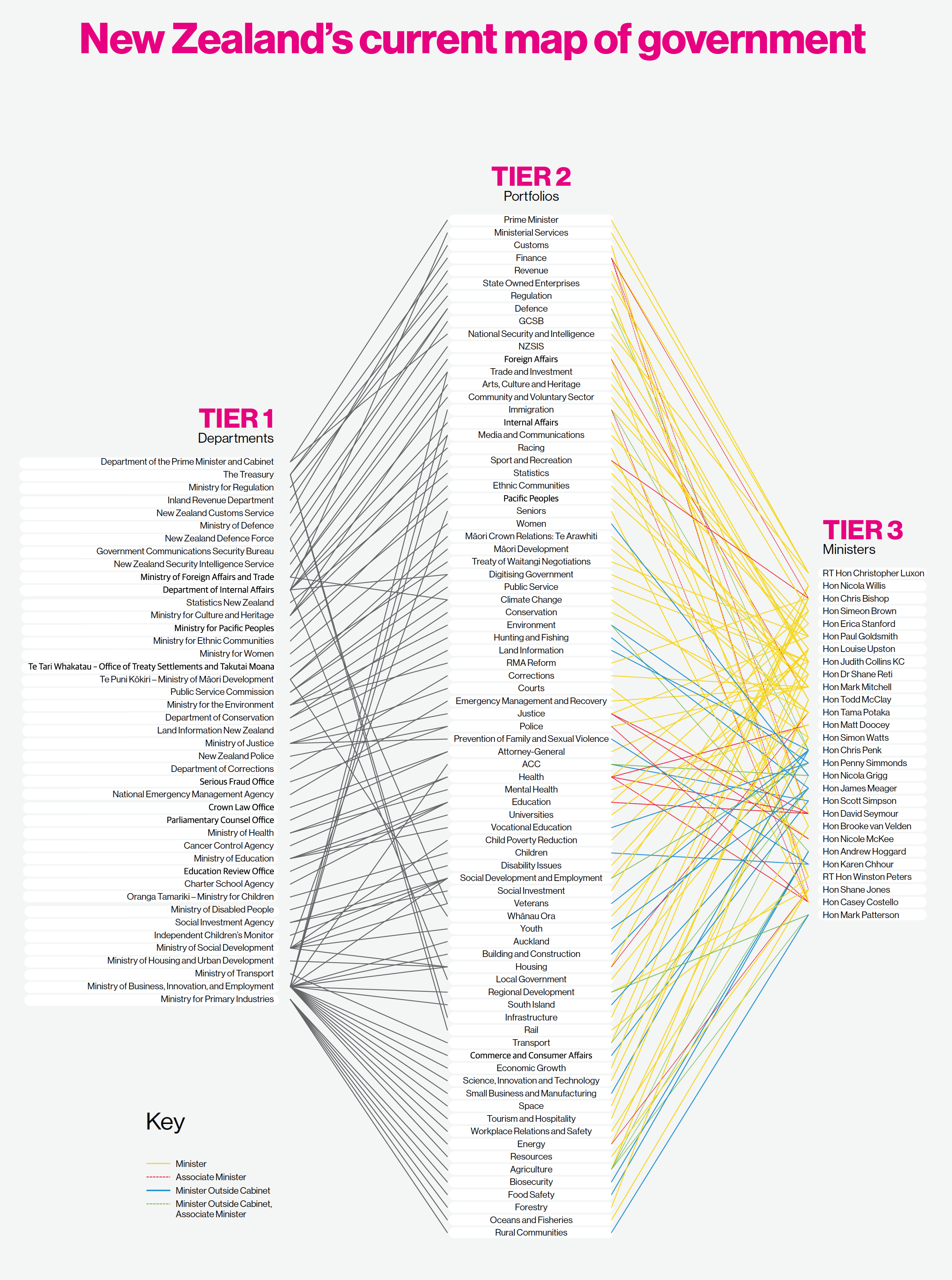 Click here for larger version.
Take the Ministry of Business, Innovation and Employment (MBIE), as an example. It plays off against answers to twenty different ministers!
So no one is clearly in charge, and it shows.
Grasping the mantle of our complaints last year (see Taxpayers' Union: End the Ministerial Maze: Time to Cut Cabinet Down to Size) and the excellent work done by our friends at the NZ Initiative think tank, ACT has proposed to bring New Zealand into line with other countries of our size and cut Cabinet down to just eighteen.
David Seymour released a detailed plan including:
- Consolidating New Zealand's 43 departments into 19.
- Reducing 78 overlapping portfolios with 28 ministers into just 18 ministers.
- Having each department report to one minister for its budget and outcomes.
ACT say it would look something like this:
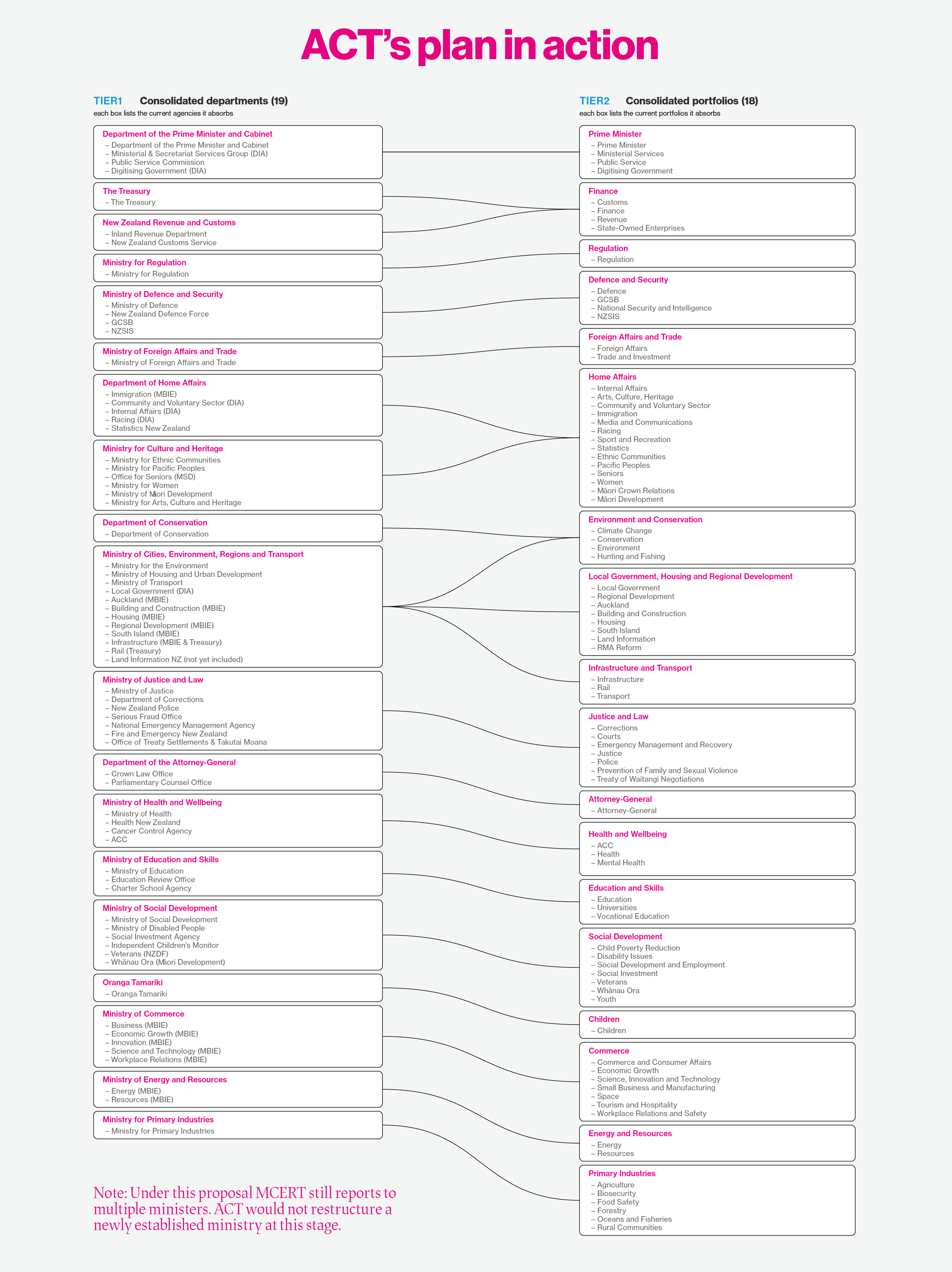 Click here for larger version.
But Seymour wants to go even further to increase accountability from ministries. He proposes to change the law to allow ministers to appoint their chief executives (for a fixed term) and give them the power to remove public sector bosses for non-performance or policy misalignment.
Right now, ministers don't even select the bureaucrats who run their departments - nor can they sack them. That's all done by the Public Service Commissioner.
Now, reasonable minds can differ on whether the public service heads should be political appointments. But, even putting the last proposal aside, we think ACT's policy would benefit taxpayers.
When a ministry answers to multiple ministers, no one is in charge. That means delays, excuses, and wasted money.
Fewer ministers = more accountability 🥊
The current structure has led to confusion, obfuscation, and waste. Having one minister each responsible for their own ministry would make a lot of sense to most Kiwis.
Democracy is broken when the average voter can't work out who is in charge of what. Whether your preference is smaller government, bigger government, or in between, most would agree New Zealand needs smarter and more accountable government.
Fewer ministers in charge of fewer ministries makes that more likely.
You can read the policy paper here, or watch David Seymour's speech/announcement (via RNZ) here.
Labour doesn't know what a GP is (free or otherwise)! 😂
Poor old Chris Hipkins. First he struggled to tell what a woman is, and now he's struggling tell the difference between a doctor and a nurse!
It turns out, Labour's three "free" (taxpayer-funded) GP visits aren't what they seem.

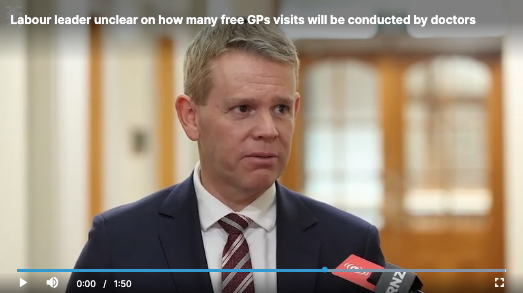
Last week, things got a little awkward when journalists asked Chris Hipkins a rather obvious question about the policy: would nurse practitioners stand in for doctors given there's already a shortage?
He didn’t know the answer. Apparently nobody in Labour does! Labour’s Health spokesperson Ayesha Verrall also couldn't say.
Watch Chris Hipkins try to explain why a nurse visit is the same as a GP visit...
All Greens in a sea of red? The $800m “typö” 😳
Goodness knows the Taxpayers' Union makes plenty of typos. As much as we try to spot them, those bloody ‘hellp’ (hello), ‘teh’ (the), ‘seperate’ (separate) sneak their way in. I'm still given stick for once having ‘pubic’ in stead of ‘public’ in an email subject line sent to my closest 200,000 taxpayer friends. 🤦♂️
But the Greens have really stepped it up...
Last week, Chlöe Swarbrick redefined what it means to have a typo, after saying a mistake of $800 million in their policy announcement was just that. A “typo”.
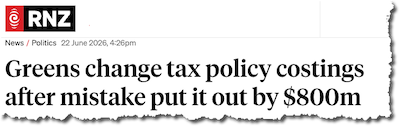
But it wasn't just a typo. The numbers were right, but the cost of their policy was added onto the revenue side of the equations setting out the costs of their laundry list of new taxes.
Swarbrick tried to downplay the error, saying the $800m blunder is "of no material impact" to the policy.
Try looking Kiwi households in the eye and telling them that $360 each means nothing...
It's not a typo, nor should it be dismissed. The Greens released a policy having not had anyone properly run their eyes over the arithmetic. Poor form, guys.
How can voters have accurate costings, when the parties can't even get it right? 🤔
This isn't the first multi-million mistake in election policy costings. And whilst your humble Taxpayers' Union and efforts like our pre-election 'Bribe-O-Meter' assist things, there's got to be a better way to ensure accuracy.
Since 2014, we've been calling for the establishment of an independent body to provide parties and the public non-partisan costings on their policies.
We repeated the call as recently as National's claim that Labour has a $18.2 billion gap between promised spending and revenue measures. How can the average punter (let alone a journalist) verify the contradictory claims between the parties about what adds up?
We’ve seen versions of an Independent Office of Budget Responsibility work in both the UK and Australia, so why doesn't New Zealand get on board?
When Ruth Richardson and Helen Clark both agree New Zealand would benefit from an Independent Budget Office, maybe it's an idea whose time has come?
Writing for the NZ Herald, Katie Bradford took a deep dive into how the Australian version of what we propose works there. It's definitely worth a read: Could an Australian-style Budget watchdog fix NZ's fiscal fights?

Click here to read over on NZHerald.co.nz
Are National caving-in on local government's calls for new taxes? 😡
Ratepayer-funded sock-puppet lobby group "Local Government New Zealand" are at it again.
This time, they're using ratepayer money to promote a campaign by some mayors (most notably, Auckland's Wayne Brown) to literally tax Kiwis for going on holiday!

Mayors across the country are promoting a new tax travellers wrapped up as a “bed tax” on accommodation.
And the Government appears to be considering it, at the very least for Auckland.
No new taxes: Hands OFF our holidays! 🏕️
Taxing international visitors is one thing, but the vast majority of a bed tax would be paid by Kiwis going on holidays or needing to stay in short term accomodation - say if you're visiting a sick relative and need to stay at an Airbnb, campsite, or book a bach (all of whom already pay rates).
No, no, no. After GST, fuel taxes, road user charges, council rates, and income taxes; that’s plenty enough.
New taxes have the nasty habit of growing once introduced – and do you really trust councils not to price gouge once they have a new taxing power?
This “alliance” of mayors have claimed the tax would help provide needed extra revenue from visitors. But until rates are capped and locals are ruled out, we disagree.
Radical idea: how about councils learn to live within the revenue they already collect? 😤
Does New Zealand hate success? 🚀
The social media comments ran hot this week after we ran a piece by Taxpayers' Union hero supporter, Nick Stewart, arguing the the entrepreneur who creates a successful business doesn't make the pie smaller, but bigger!

Creating a business = more jobs = more investment = more innovation = more opportunity. In this economy (and every economy) that should be celebrated.
Nick opines:
I want to make the unfashionable case. Not for Musk the man, he hardly needs my help, but for what the exception represents: the rare individual who turns the stuff of science fiction into things we use every day without a second thought, the smartphone in your pocket, the satellite that carries your call, the online payment that clears in seconds, the electric car at the lights, the cloud software that runs the small business down the road. Continue reading...
And while many politicians would have you believe that wealth creation depends on taking from the poor, it's refreshing to see the media occasionally run the other perspective.
Because the "success is suspicious" mindset underpins too many of the tax proposals we're seeing overseas and in in many cases the Greens, Te Pāti Māori, and Labour.
But to improve New Zealand's productivity, growth, and living standards we need innovators who are willing to take risks, build, spend, and invest.
Nick makes the case well and it's worth the read via the NZ Herald website here (requires sub), or via the Stewart Group's website here).
Oh, and if you dare do jump into the comments...
That's all for today, thanks for your support.
 |
|

In the Media:
The Platform Ruth Richardson On The Fatal Flaws In National’s KiwiSaver Policy
More FM More FM 9am - Item 3
NZ City A group of councils is under fire - for steep rises in rates and water bills
The Post National's KiwiSaver plan double-charges workers
Waikato Times National's KiwiSaver plan double-charges workers
NZ Herald Thomas Coughlan: Is Christopher Luxon flying - or falling with style?
Otago Daily Times Their wars here
RNZ Lobby group says cutting Wellington's commercial rates differential is not the answer
The Post Tiaki Wai expands to new $600k-a-year waterfront office
The Platform David Farrar On TOP & The Sympathetic Media Coverage From MSM
Newstalk ZB Politics Thursday with Paul Goldsmith and Willie Jackson
The Spinoff The Greens need to commit more crimes The Greens need to commit more crimes
Northern Advocate Govt needs to make pupils safe
Newstalk ZB The Huddle: Does TOP really stand a chance this election season?
The Standard Daily review 24/06/2026
Newstalk ZB Full Show Podcast: 24 June 2026
Newstalk ZB Thomas Coughlan: NZ Herald Political Editor on National accusing Labour of having a "hidden bill"
The Platform Last Night’s TVNZ/Verian Poll - The Centre-Right Are In Trouble.
Newstalk ZB Morning Edition: 24 June 2026
NZ Herald Abuse and threats surge against Auckland councillors after rates hike
Interest.co.nz Politicians want New Zealanders to save this election, but can they save themselves?
RNZ Greens up on every measure in IPSOS polling
ThreeNews ThreeNews 6pm - Item 2
Newstalk ZB The Panel: Immigration staff scandal, 4 hour traffic jams and Wayne versus Winston


