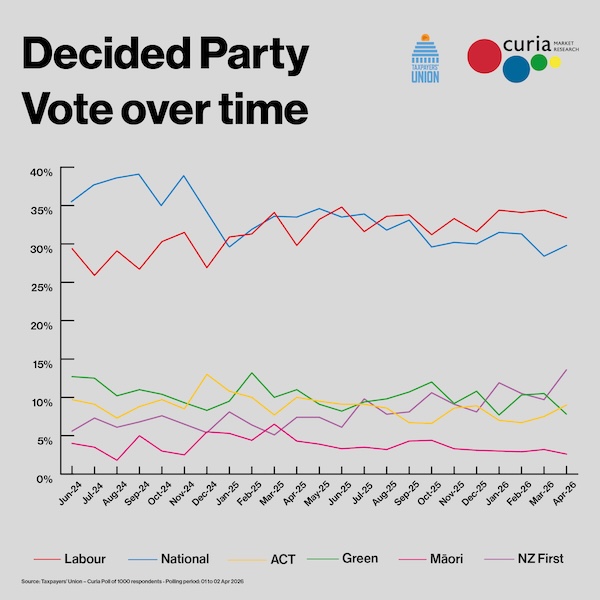
Here are the headline results for April's Taxpayers’ Union – Curia Poll:
|
Party |
Support |
Change compared to March 2026 |
|
Labour |
33.4% |
↓1.0 |
|
National |
29.8% |
↑1.4 |
|
NZ First |
13.6% | ↑3.9 |
|
ACT |
9.0% |
↑1.5 |
|
Green |
7.8% |
↓2.7 |
|
Te Pāti Māori |
2.6% |
↓0.6 |
|
Other |
3.8% |
↓2.5 |
Labour is down 1.0 points to 33.4%, while National is up 1.4 points to 29.8%. New Zealand First is up 3.9 points to 13.6%, while ACT is up 1.5 points to 9.0%. The Greens are down 2.7 points to 7.8%, while Te Pāti Māori is down 0.6 points to 2.6%
The combined result of “other parties” this month is 3.9%, including TOP on 2.6% (+0.7 points). NZ Outdoors and Freedom, Vision NZ, and New Conservatives were all on 0.0% in this poll.
This month's results are compared to the last Taxpayers' Union-Curia poll conducted in March 2026.
|
Party |
Seats |
Change compared to March 2026 |
|
Labour |
42 |
↓2 |
|
National |
37 |
↑1 |
|
NZ First |
17 |
↑4 |
|
ACT |
11 | ↑1 |
|
Green |
10 |
↓3 |
|
Te Pāti Māori |
3 |
↓1 |
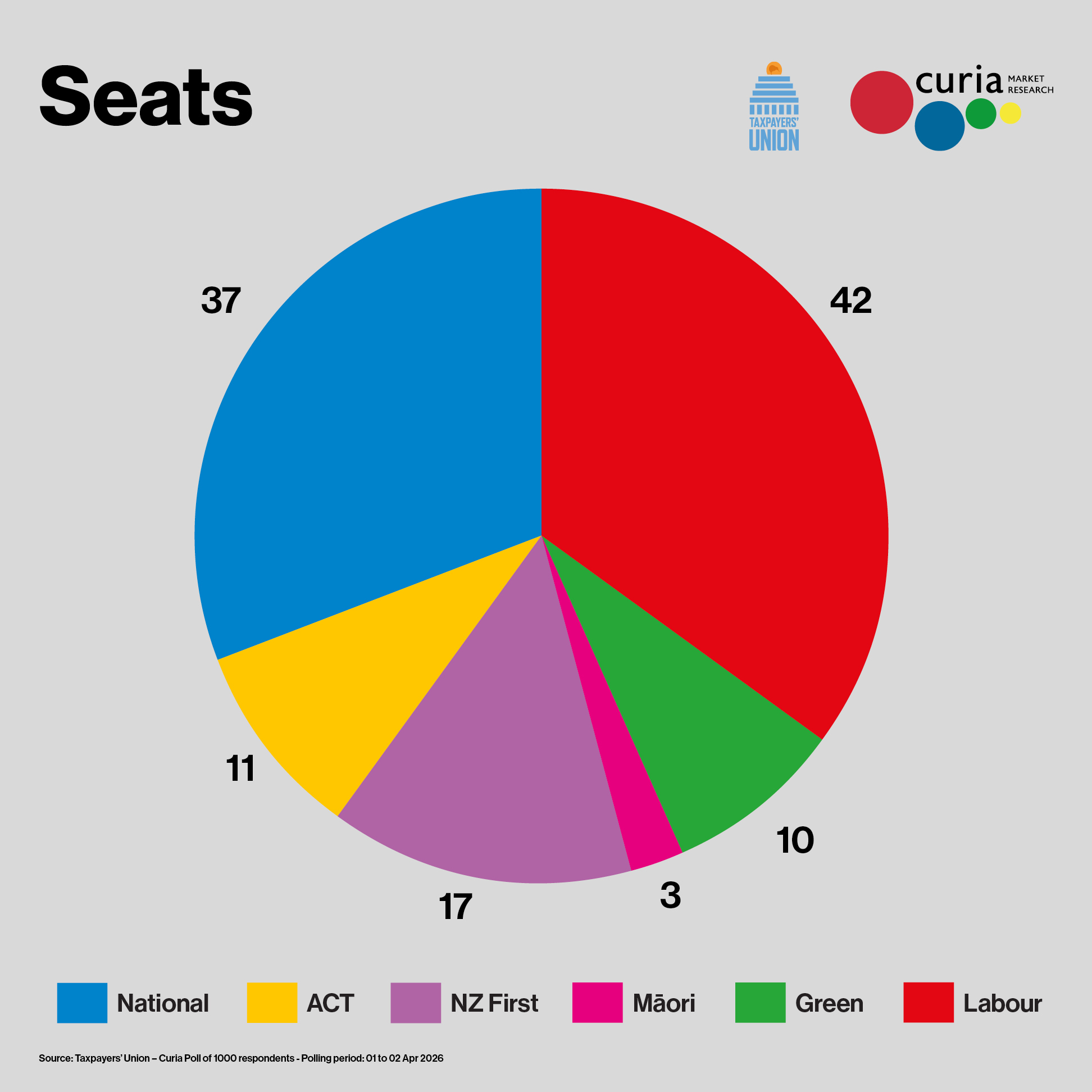
This shows how many seats each party would win in Parliament, based on the decided vote.
Labour drops 2 seats to 42, while National gain 1 to achieve 37 seats.
New Zealand First gains 4 seats to 17, while ACT gains 1 seat to 11. The Greens drop 3 to 10 seats, while Te Pāti Māori lose 1 on 3 seats.
This calculation assumes there are no overhang seats for National and Te Pāti Māori. An explainer for this assumption can be found here.
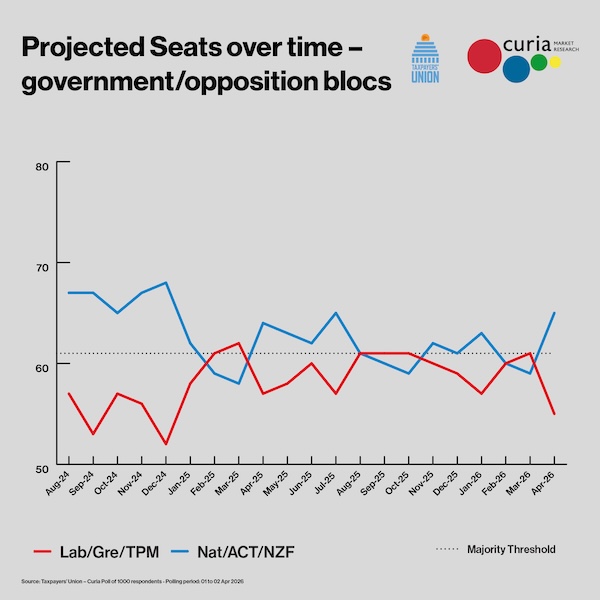
The combined projected seats for the Government parties bloc is up 6 seats to 65.
The combined seats for the Opposition parties bloc is down 6 to 55.
On these numbers, the current three parties of Government would be able to form a Government.

The left bloc (Labour plus the Greens) remain stronger on 52 seats (down 5) compared to the right bloc (National plus ACT) which are on 48 seats this month
(up 2).
The last time either bloc commanded a majority without needing a support partner (NZ First or Te Pāti Māori) to be able to form a government was December 2024.
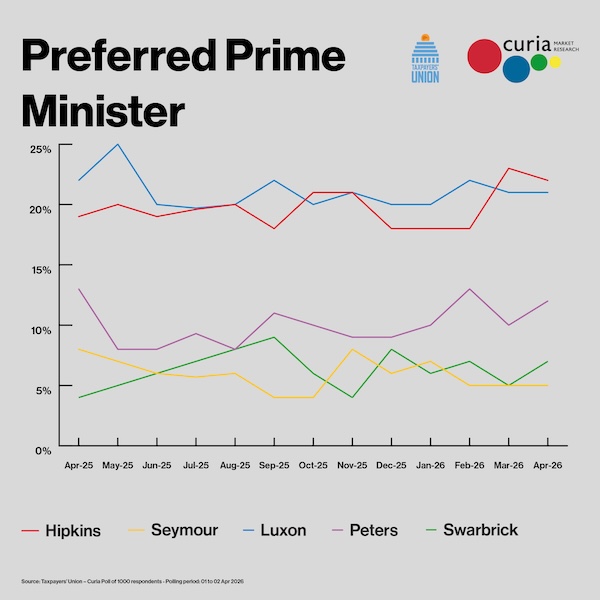
Chris Hipkins is down 1.0 points to 21.7%, while Christopher Luxon is down 0.5 points to 20.5%.
Winston Peters is up 1.7 points to 12.1%, Chlöe Swarbrick is up 2.8 points to 7.4 while David Seymour is down 0.6 points to 4.6%.
For the full polling report, covering the detailed insights the Prime Minister and Leader of the Opposition are use to receiving, join our Taxpayer Caucus – our club of most generous financial supporters who make our work possible.
Media Summary Statement
This poll should be formally referred to as the “Taxpayers’ Union-Curia Poll”.
Any media or other organisation that reports on this poll should include the following summary statement:
The poll was conducted by Curia Market Research Ltd for the Taxpayers’ Union. It is a random poll of 1,000 adult New Zealanders and is weighted to the overall adult population. It was conducted by phone (landlines and mobile) and online between Wednesday 01 April and Thursday 02 April 2026, has a maximum margin of error of +/- 3.1% and 5.3% were undecided on the party vote question.
Notes
The scientific poll was conducted by Curia Market Research and commissioned by the New Zealand Taxpayers’ Union. The full polling report is being released exclusively to members of our Taxpayer Caucus. As is well known, but for full disclosure, David Farrar co-founded the Taxpayers' Union and previously served on its board. He is also a Director of Curia Market Research Ltd.
The Taxpayers’ Union-Curia Poll was conducted from Wednesday 01 April and Thursday 02 April 2026. The median response was collected on Wednesday 1 April 2026.
The target population is adults aged 18+ who live in New Zealand and are eligible and likely to vote. The sample population is adults aged 18+ who live in New Zealand and are eligible and likely to vote who are contactable on a landline or mobile phone or online panel. 1,000 respondents agreed to participate, 700 by phone and 300 by online panel. The number of decided voters on the vote questions was 913. There were 53 (5.3%) undecided voters and 34 (3.4%) who refused the vote question.
A random selection of 10,000 NZ phone numbers (landlines and mobiles) and a random selection from the target population from up to three global online panels (that comply with ESOMAR guidelines for online research). If the call is to a landline, the person who is home and next has a birthday is asked to take part. Those who take part through an online panel are excluded from further polls on the same topic for six months.
Multiple call-backs occurred to maximise the response rate. Those who said they were unlikely or very unlikely to vote were excluded.
The poll was part of a wider omnibus survey for multiple clients. Questions on voting sentiment are asked before any other questions.
The results are weighted to reflect the overall voting adult population in terms of gender, age, and area.
Based on this sample of 1,000 respondents, the maximum sampling error (for a result of 50%) is +/- 3.1%, at the 95% confidence level. Results for sub-groups such as age and area will have a much higher margin of error and not seen as precise.
The polling questions and the order in which they were asked can be found here.


