
Budget 2026
We’re just out of the Beehive where the team have been in Budget 2026 ‘lock-up’ poring through Nicola Willis’s election year budget pack.
This year’s budget will be a difficult one for the Government (or the Opposition) to frame. It’s a real mixed bag.
In every Budget, there are two sets of documents. The first is the material provided by the Beehive. It’s the details of all the new spending initiatives, including a folder of spin media releases (amounting to 30 this year – a new record!), a copy of the Minister’s speech to Parliament (what you’ll see on the news), a “Budget as a Glance” glossy leaflet and an 81-page “Summary of Initiatives”.
The second set of documents is arguably more important. They aren’t written within the Beehive, but rather come out of the Treasury as a result of Ruth Richardson’s Fiscal Responsibility Act. These documents are arguably the most important. They are intended to avoid what happened in 1990 – when a new Government discovered fiscal stink bombs hidden from the public.
This is also the document where the Treasury’s forecasts on things like when we’ll get back into budget surplus, forecast GDP growth, and debt projections come from.
While the politicians want the focus on the first set, for our economic team (and us as taxpayers!) it’s the second set that really matters.
Budget 2026 in 100 words
This is an election year Budget. In the short term, it’s actually Nicola Willis’ most profligate in terms of the immediate ‘sugar hit’. It has a wide range of spending initiatives (see below) across transport, health, education, law & order, defence, and energy.
The vast majority of the “savings” come later – in 2027/28, and it is assumed the international situation gets back to normal in the short term.
Compared to December’s Half Year Economic and Fiscal Update, Treasury are forecasting real GDP to be lower, nominal GDP to be higher and the OBEGALx* returning to surplus one year earlier.
*you’ll recall OBGALx is a bit of a fudge – it was invented by Nicola Willis and excludes ACC liabilities.
The biggest loser – RIP National’s ‘no new taxes’ promise 🪦
“No new taxes” promise is now a distant memory: a new “banking levy tax” will be paid by savers and mortgage holders.
The biggest winner – Town Halls across the country celebrating 🏫
To our astonishment, the biggest winner from Budget 2026 is local councils! Rather than forcing councils to live within their means, the Government is going to be directly funding councils with a new $400million ($194/household) based on the number of new resource consents each council approves.
Austerity (in the short term) very much exaggerated 🤫
The Government is making much of its spending restraint. In her speech to us in the lock-up, the Minister included this slide to demonstrate her relative restraint in spending vis-à-vis the Ardern/Hipkins Government to emphasise her ‘fiscal responsibility’.
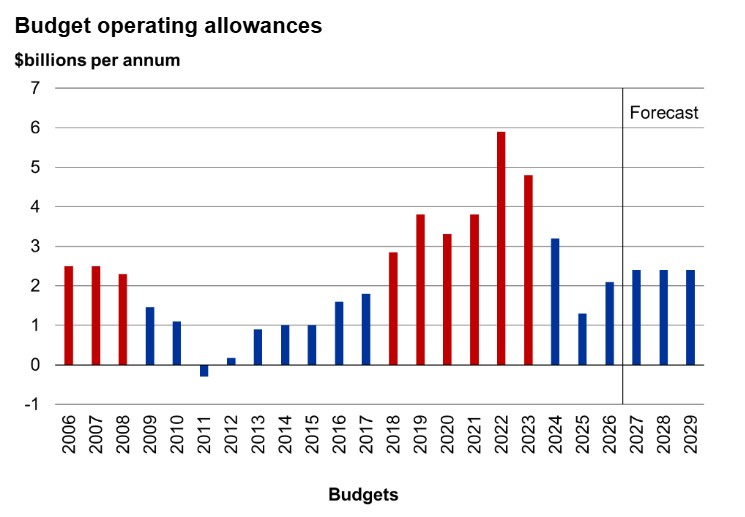
As you can see, Nicola Willis has a point. Compared to Grant Robertson, she is growing government at a slower rate.
But here’s the fly in the ointment: according to Treasury, compared to her previous budgets, and the claims that Budget 2026 is ‘no sugar hit’, this year’s budget is alarmingly expansionary. 😫
Austerity – but not until after the election ⏰
Check this out (taken from page 21 of Treasury’s economic outlook) – in the year ahead (labelled 2027 below), the overall combined effects of government consumption, investment, taxes, and transfers of Budget 2026 are not about cutting back in the short term. As you can see, the consolidation is after the election.
This is what we mean, we criticise Nicola Willis for saying all the right things, but pushes the savings until later…

Lord, give me fiscal virtue, but just not right now…
Summary of Initiatives (New Spending)
Here's the snapshot provided by the Government. 


New taxes
As well as the new banking levy tax, there are changes to the way foreign investments are taxed. We don’t have our head around the technical details yet (our team are actually headed to a separate briefing with the IRD at 4pm), but from what we can tell so far, it looks to be good and tackle an unfair quirk that saw ‘deemed dividends’ that were taxed regardless of actual cashflows.
There are also tax changes to non-profits and a new limit to tax-deductible donations. This will cap the tax credit to $33,333 per year.
Fine for mum and dad givers to charities, but very bad news for those who want to give away the bulk of their wealth towards the end of their life to, say, build a hospital or buy ambulances. It may also have major implications for charity-owned trading companies. Again, we’ll have more to say once we’ve had the briefing from IRD this afternoon.
The Budget Pack
In the last few minutes, the Budget Documents went online at https://budget.govt.nz/index.htm
Our media releases and commentary are here:
- Spend today, save tomorrow: Budget 2026 promises restraint, eventually
-
RIP National’s ‘No new taxes’ promise: New $209 million “banking tax” will hammer savers and mortgage holders
- Watts hands councils $400 million while ratepayers wait
- Budget 2026 delivers a sugar hit for new spending
Summary
Budget 2026 is a good first step in terms of getting New Zealand’s unaffordable spending and debt trajectory under control. Would we have preferred more? Of course. Would we have preferred sooner? Absolutely.
But credit where credit is due: Nicola Willis is being honest with New Zealanders that the spending path created by the last Labour-led Government is unsustainable. Without wholesale correction, of course, New Zealand is on a path to a debt shock not seen since the early 1990s.
Economic uncertainty is high. While this year’s budget projects a surplus in 2029 or 2030 (depending on the measure used), that all relies on positive terms of trade, and the oil/security situation following a rosy path.
Let’s hope that pans out.
Thank you for your support.
 |
|
